
Total System Health is reader‑supported. When you purchase through links on our site, we may earn an affiliate commission at no additional cost to you. For more details, please see our Privacy Policy.
[TOTAL SYSTEM NOTE] ecobee vs Nest 4th Gen is not a typical smart thermostat comparison — it’s a system-level analysis of how each device impacts indoor air quality, energy efficiency, and long-term home health. To see how it works with your energy infrastructure, read our breakdown of the Emporia Vue 3 vs Refoss EM16 Energy Monitor — the diagnostic tool that shows you exactly what your HVAC is costing you in real time.
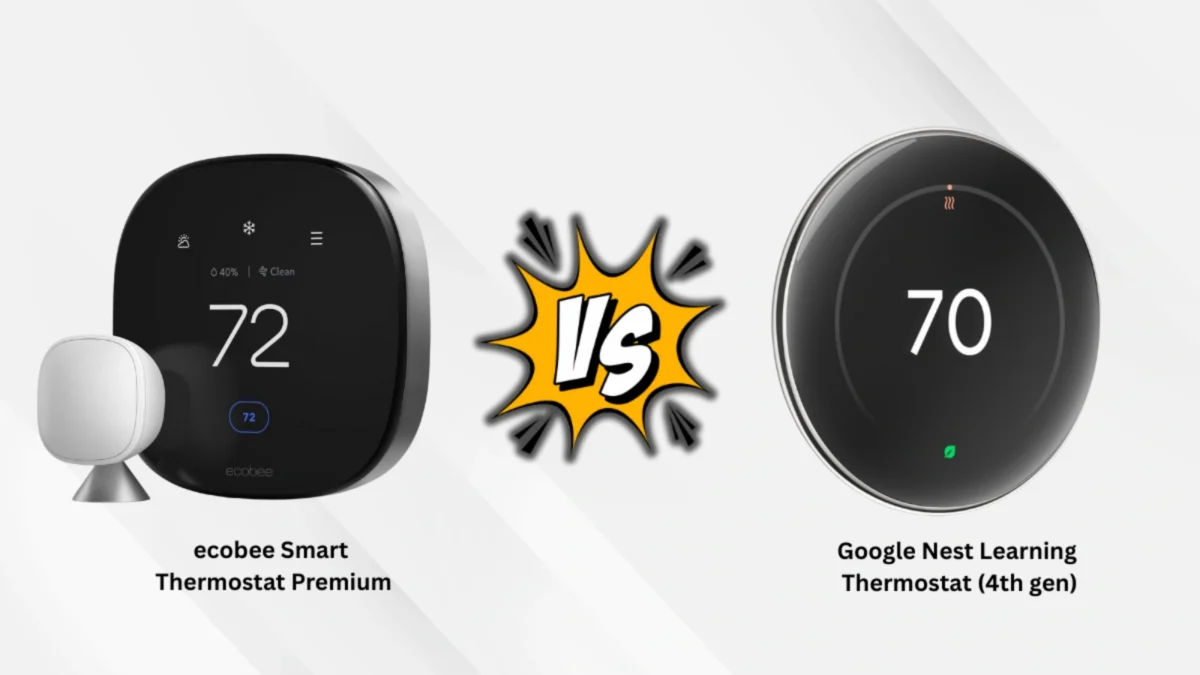
The ecobee Smart Thermostat Premium wins for health-conscious homeowners who need air quality monitoring, multi-room sensor control, and broad smart home compatibility. The Google Nest (4th Gen) wins for homeowners already inside the Google ecosystem who want the sharpest design, Matter protocol support, and the most intuitive learning automation on the market.
Both retail between $249–$280. Neither is a wrong choice. But they solve different problems — and for a home optimized around systemic health, the differences matter more than most comparison reviews admit.
This is not a gadget review. This is a system-level analysis of which device better reduces the chronic, low-grade stress your HVAC places on your biology, your budget, and your home infrastructure over time.
What Is the ecobee Smart Thermostat Premium and Who Is It For?
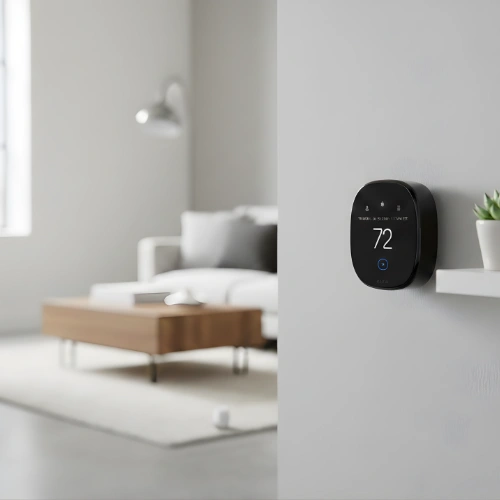
The ecobee Smart Thermostat Premium is a 24VAC hardwired smart thermostat built around the idea that climate control and home health are the same problem. It retails for $249.99, includes a SmartSensor (a $50 value) in the box, and ships with a Power Extender Kit for homes without a C-wire.
Its standout feature — the one no competitor currently matches at this price — is the built-in air quality monitor that measures relative humidity, VOCs (volatile organic compounds), and equivalent CO₂ (eCO₂) levels in real time. For anyone who has invested in water filtration, air purification, or indoor environmental systems, this is the logical command center.
It is best for homeowners who want:
- Multi-room temperature and occupancy sensing (supports up to 32 SmartSensors)
- Built-in Alexa and Siri voice control without needing a separate speaker
- Apple HomeKit, Google Assistant, SmartThings, and IFTTT compatibility simultaneously
- Indoor air quality data as part of their daily home health protocol
- 3-year manufacturer warranty (the longest in this category)
→ Check current ecobee Premium price and availability on Amazon
What Is the Google Nest Learning Thermostat (4th Gen) and Who Is It For?
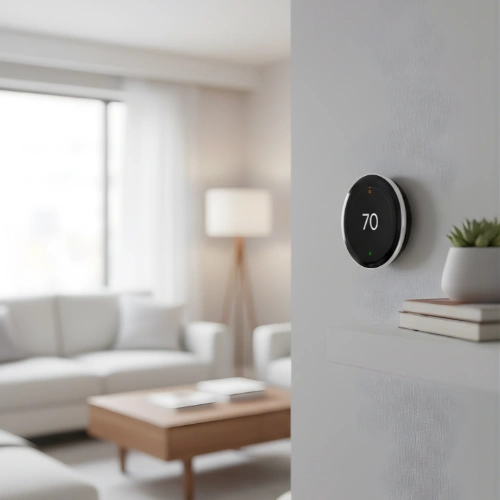
The Google Nest Learning Thermostat (4th Gen) launched in August 2024 — nine years after the 3rd generation — and represents a complete redesign. It retails for $279.99, includes a Nest Temperature Sensor (2nd gen) in the box, and is powered by Google’s Gemini AI for adaptive learning and energy-shifting automation.
Its standout features are a borderless 2.7-inch display that is 60% larger than its predecessor, Matter protocol support (making it the most forward-compatible thermostat in this comparison), and a System Health Monitor that proactively flags HVAC issues before they become failures.
It is best for homeowners who want:
- The most visually premium thermostat on the market with a polished domed glass display
- Deep Google Home and Google Assistant integration
- Gemini AI-powered learning that adjusts automatically based on your schedule, weather, and occupancy
- Matter compatibility for cross-platform control via Apple Home, Alexa, or any Matter app
- Clean, minimal setup with no C-wire required in most homes
→ Check current Google Nest 4th Gen price and availability on Amazon
ecobee Premium vs. Google Nest (4th Gen): Full Spec Comparison Table
| Spec | ecobee Smart Thermostat Premium | Google Nest Learning Thermostat (4th Gen) |
|---|---|---|
| Price | $249.99 | $279.99 |
| Display Size | 3.5-inch touchscreen | 2.7-inch LCD (borderless, domed glass) |
| Display Type | Flat touchscreen (low glare) | Curved glass (can glare in bright rooms) |
| Included Sensor | SmartSensor (temperature + occupancy) | Nest Temperature Sensor 2nd gen (temperature only) |
| Max Sensors | Up to 32 SmartSensors | Multiple Nest sensors (temperature only) |
| Occupancy Sensing | Yes — SmartSensor detects motion | Yes — Soli radar sensor built into thermostat |
| Air Quality Monitor | ✅ Yes — VOCs, eCO₂, humidity | ❌ No |
| Built-in Voice Assistant | ✅ Alexa + Siri built-in | ❌ No built-in speaker |
| Voice Control (External) | Alexa, Siri, Google Assistant | Alexa, Siri (via HomeKit), Google Assistant |
| Apple HomeKit | ✅ Yes — native | ✅ Yes — via Matter |
| Matter Support | ❌ Not yet as of 2026 | ✅ Yes — Matter certified |
| Google Home | ✅ Compatible | ✅ Native |
| SmartThings / IFTTT | ✅ Yes | ✅ Yes |
| Learning / AI | eco+ (suggests schedule changes, time-of-use optimization) | Gemini AI (automatic learning, Adaptive Eco, Energy Shift) |
| Schedule Learning Style | Suggests changes, user approves | Learns automatically, makes changes |
| HVAC Health Monitoring | Alerts for temperature drops, equipment anomalies | System Health Monitor — proactive HVAC diagnostics |
| Geofencing | ✅ Yes (1 phone native; multi-phone requires setup) | ✅ Yes (multi-phone, integrates with Google devices) |
| C-Wire Required | No — Power Extender Kit (PEK) included | No — Power Sharing technology |
| System Compatibility | 95% of 24V systems (furnaces, ACs, heat pumps, boilers, PTACs) | Most 24V systems — not compatible with electric baseboard |
| HVAC Accessories | ✅ Humidifiers, dehumidifiers, HRVs, ERVs | ✅ Ventilation, humidifiers, dehumidifiers |
| Energy Savings Claim | Up to 26% / year (~$284 savings) | Up to 31% / year |
| Warranty | 3 years | 2 years |
| Colors/Finishes | 1 (brushed nickel) | 3 (Polished Silver, Gold, Obsidian) |
| Security Hub Features | ✅ Smoke detection, doorbell cam integration, Smart Security | ❌ Not a security hub |
| Install Time | ~30–45 min DIY | ~40 min DIY |
| ENERGY STAR Certified | ✅ Yes | ✅ Yes |
Check ecobee Premium Price on Amazon
Why Your Thermostat Is a Health Infrastructure Decision, Not a Convenience Purchase
Most thermostat comparisons stop at energy savings and app design. That framing misses the actual function of a smart thermostat inside a health-optimized home.
Your HVAC system runs an average of 8 to 12 hours per day. Every cycle it completes either deposits or removes particulates, humidity, VOCs, and CO₂ from your breathing environment. A thermostat that only controls temperature is like a car dashboard that only shows speed — it is missing the data your system actually needs to protect you.
The average American spends 90% of their time indoors. The EPA has consistently documented that indoor air pollutant levels can run 2 to 5 times higher than outdoor levels. Your thermostat sits at the center of the one system — your HVAC — that can either circulate and dilute those pollutants or trap and concentrate them.
This is why the air quality monitoring difference between these two devices is not a spec-sheet footnote. It is a system-level decision.
Does the ecobee’s Air Quality Monitor Actually Matter for Your Home?
The ecobee Smart Thermostat Premium measures three things the Nest (4th Gen) does not: relative humidity, VOCs (volatile organic compounds), and equivalent CO₂ (eCO₂).
Here is what each of those measurements does inside a health-optimized home system:
Relative Humidity is the most immediate biological stressor your HVAC controls. The EPA and ASHRAE both identify the 40–60% relative humidity range as the target zone for minimizing dust mite activity, mold growth risk, respiratory irritation, and viral survival rates. Below 30%, mucous membranes dry out and lose their filtration function. Above 60%, mold colonies can establish on surfaces within 24 to 48 hours. The ecobee monitors this continuously and alerts you when your home drifts outside the safe zone. The Nest does not.
VOCs (Volatile Organic Compounds) are off-gassed by furniture, flooring, cleaning products, paints, and building materials. Many are classified as probable carcinogens at chronic low-level exposure. The ecobee’s eCO₂ sensor uses VOC data as a proxy for overall indoor air quality and triggers an alert when levels rise above a threshold that suggests the space needs ventilation. This is especially relevant if you have invested in any home improvement, renovation, or new furniture — all of which spike VOC levels for weeks to months after installation.
eCO₂ (Equivalent CO₂) is a measure of air freshness and cognitive load. Research published in the Harvard T.H. Chan School of Public Health found that indoor CO₂ levels above 1,000 ppm are associated with measurable declines in cognitive performance — specifically in decision-making, focus, and response accuracy. The average bedroom with windows closed overnight routinely exceeds 1,200 ppm. The ecobee flags this. The Nest does not measure it at all.
The System-Level Verdict on Air Quality: If you are running a HEPA air purifier, a whole-house water filtration system, or any other environmental health infrastructure, the ecobee’s air quality monitor is the feedback layer that tells you whether those investments are working. Without measurement, you are optimizing blind.
How Does the Nest (4th Gen) HVAC System Health Monitor Compare?
Check Google Nest 4th Gen Price on Amazon
To be fair to the Nest, it brings a system-level capability the ecobee does not match: proactive HVAC health monitoring. The Nest’s System Health Monitor uses sensor data, runtime patterns, and AI analysis to detect anomalies in your heating and cooling equipment — flagging potential compressor inefficiency, refrigerant issues, or filter degradation before they become a breakdown.
For a Total System Health framework, this matters. An HVAC system running at degraded efficiency doesn’t just cost more to operate — it distributes particulates and recirculates unfiltered air at higher rates because clogged or failing components reduce airflow velocity and filtration effectiveness.
The Nest’s System Health Monitor functions like a diagnostic scan of your home’s mechanical infrastructure. The ecobee offers maintenance reminders but does not perform the same level of predictive system analysis.
Bottom line: The ecobee monitors your air. The Nest monitors your equipment. In a fully optimized home, you want both. In a head-to-head choice, the air quality data has higher daily biological relevance for the health-conscious homeowner — but if your HVAC is aging or has a history of issues, the Nest’s equipment monitoring is a compelling counterargument.
ecobee vs. Nest: Multi-Room Sensor Architecture Compared
This is where the two systems diverge most significantly in real-world performance.
The ecobee’s SmartSensors measure both temperature AND occupancy (motion). This means the ecobee can do something the Nest cannot: it knows which rooms are actively being used and prioritizes conditioning those rooms specifically. If your bedroom SmartSensor detects occupancy during sleep hours, the ecobee can instruct your HVAC to maintain your target temperature in that room specifically — even if the rest of the house is drifting.
The Nest Temperature Sensor (2nd gen) included with the 4th Gen measures temperature only — no motion, no occupancy. This limits the Nest’s ability to follow occupancy patterns through the home. The Nest uses its built-in Soli radar sensor to detect presence near the thermostat itself, but that does not extend room-by-room the way ecobee’s distributed occupancy sensing does.
For a multi-room home where different family members use different spaces at different times — which describes most households — the ecobee’s dual-function sensors are a structural advantage that compounds over time. Each occupied-room optimization reduces unnecessary HVAC runtime in unused spaces, which is where a meaningful portion of the energy savings come from.
| Sensor Capability | ecobee SmartSensor | Nest Temperature Sensor (2nd gen) |
|---|---|---|
| Temperature reading | ✅ Yes | ✅ Yes |
| Occupancy / motion detection | ✅ Yes | ❌ No |
| Follow Me (occupancy-based conditioning) | ✅ Yes | ❌ Not supported |
| Smart Home/Away automation | ✅ Sensor-driven | ✅ Phone GPS + built-in Soli only |
| Max sensors supported | 32 | Multiple (temperature only) |
| Appears in smart home apps as trigger | ✅ Yes (motion trigger for automations) | ❌ No |
| Sensor cost (additional) | ~$49 per SmartSensor | ~$39 per Nest Temperature Sensor |
5-Year ROI and Total Cost of Ownership Comparison
This is the section that matters for anyone making a long-term infrastructure decision. We are calculating the true cost of each system over 5 years, including purchase price, energy savings, and the cost of additional sensors for a 3-bedroom home.
Assumptions used in this calculation:
- Average U.S. household annual heating and cooling cost: $1,091 (U.S. Energy Information Administration, 2024 average)
- ecobee verified energy savings: up to 26% per year (ecobee internal analysis, confirmed ENERGY STAR certified)
- Nest energy savings claim: up to 31% per year (Google, based on Nest Renew and Adaptive Eco features)
- 3-bedroom home sensor setup: 3 additional sensors beyond the 1 included in the box
- Prices current as of early 2026
| Cost Factor | ecobee Smart Thermostat Premium | Google Nest Learning Thermostat (4th Gen) |
|---|---|---|
| Purchase price | $249.99 | $279.99 |
| Included sensor value | SmartSensor (~$49 value) | Nest Temp Sensor (~$39 value) |
| Additional sensors (3 rooms) | 3 × $49 = $147 | 3 × $39 = $117 |
| Total hardware investment | $396.99 | $396.99 |
| Annual energy savings (est.) | ~$284/year (26% of $1,091) | ~$338/year (31% of $1,091) |
| 5-Year energy savings | ~$1,420 | ~$1,690 |
| 5-Year net ROI | +$1,023 | +$1,293 |
| Payback period | ~17 months | ~14 months |
| Warranty coverage | 3 years | 2 years |
| Warranty value (repair avoided) | Higher — 1 extra year covered | Standard |
What this means in plain language: Both devices pay for themselves in under 18 months. Over 5 years, the Nest’s higher energy savings claim generates approximately $270 more in savings — roughly offsetting its $30 higher purchase price and then some. However, the Nest’s savings figure is Google’s own claim, while ecobee’s 26% figure is validated against an external ENERGY STAR analysis. The Nest’s 31% figure has not been independently verified to the same standard.
The real ROI differentiator is not the thermostat itself — it is whether you deploy sensors effectively in every occupied room. Both systems underperform significantly if sensors are not placed in the rooms where your family actually spends time.
In the ecobee vs Nest 4th Gen debate, the real difference isn’t design or apps — it’s whether you value air-quality feedback or HVAC self-diagnostics more.
Which Smart Home Ecosystem Are You Already In?
This is the question most comparison articles skip — and it is the single most practical filter for making the right decision. Buying a thermostat that fights your existing ecosystem wastes money, creates friction, and results in a device you underuse.
Here is a direct breakdown by ecosystem:
You are in the Apple ecosystem (iPhone, HomePod, Apple Watch, Apple HomeKit): The ecobee Premium is the stronger choice. It has native Siri support built directly into the thermostat — no hub required beyond an Apple HomePod or HomePod mini. It integrates fully into Apple Home automations, appears as a native device in the Home app, and works alongside your other HomeKit accessories without workarounds. The Nest 4th Gen does support Apple HomeKit via Matter, which works — but the experience is deeper and more direct on ecobee.
You are in the Google ecosystem (Android, Google Home, Nest cameras, Google Assistant): The Nest 4th Gen is the natural choice. It is natively designed for Google Home, works seamlessly with other Nest devices for Home/Away Assist across multiple phones, and its Gemini AI learns from your Google account activity patterns in ways that require no manual input. If you already have Nest cameras, a Google Nest Hub, or any other Google Home devices, the Nest thermostat operates as a fully integrated node in that network rather than a compatible-but-separate device.
You are in a mixed or platform-agnostic home: The ecobee Premium has the broadest simultaneous compatibility of any thermostat in this category — Apple HomeKit, Amazon Alexa, Google Assistant, SmartThings, and IFTTT all at once, with no trade-offs. The Nest 4th Gen’s Matter support theoretically accomplishes the same cross-platform goal, but Matter on thermostats is still maturing, and real-world reports in 2025 confirm occasional sync delays between the Nest and non-Google platforms. The ecobee’s multi-platform track record is longer and more stable.
You are building a health-first smart home with air quality, water filtration, and environmental monitoring systems: The ecobee Premium is the correct infrastructure choice. Its built-in VOC, eCO₂, and humidity monitoring integrates your climate control system directly into your environmental health stack. It is designed to be a hub — not just a thermostat — and that philosophy aligns directly with the Total System Health framework of treating your home as a connected biological system.
ecobee vs. Nest: Smart Home Compatibility Side by Side
| Platform | ecobee Smart Thermostat Premium | Google Nest (4th Gen) |
|---|---|---|
| Amazon Alexa | ✅ Native + built-in speaker | ✅ Compatible (external speaker required) |
| Google Assistant | ✅ Compatible | ✅ Native |
| Apple HomeKit / Siri | ✅ Native (HomePod required for Siri) | ✅ Via Matter |
| Samsung SmartThings | ✅ Yes | ✅ Yes |
| IFTTT | ✅ Yes | ✅ Yes |
| Matter Protocol | ❌ Not yet (2026) | ✅ Certified |
| Home/Away (multi-phone) | ⚠️ Single phone native; multi requires setup | ✅ Multi-phone, seamless |
| Works as smart speaker | ✅ Yes — Alexa + Spotify + Amazon Music | ❌ No built-in audio |
| Doorbell camera integration | ✅ ecobee Smart Doorbell Camera live feed | ❌ No display integration |
| Security hub features | ✅ Smoke detection, door/window sensors | ❌ Not a security hub |
| Generac generator integration | ✅ PWRcell 2 solar battery integration | ❌ No |
How Difficult Is Each Thermostat to Install?
Both devices are designed for DIY installation in under 45 minutes, and both handle the most common installation obstacle — no C-wire — without requiring an electrician.
ecobee Premium Installation: The ecobee requires a C-wire for consistent 24VAC power, but ships with a Power Extender Kit (PEK) in the box that replaces the need for a physical C-wire in most homes. Compatible with 95% of 24V systems including furnaces, central ACs, heat pumps (2H/2C with 2-stage AUX), boilers, PTACs, and fan coil units with up to 3 fan speeds. The installation app walks you through wiring step by step with a photograph-based interface. Most users report completing installation in 30 to 45 minutes. The ecobee is not compatible with high-voltage electric baseboard systems.
Nest (4th Gen) Installation: The Nest uses Power Sharing technology — it draws small amounts of power from your existing HVAC wiring without requiring a C-wire in most homes. Compatible with most 24V systems including gas, electric, oil, forced air, heat pumps, and radiant. Like the ecobee, it is not compatible with electric baseboard heating. In under 1% of installations, a C-wire or Nest Power Connector is necessary. The Google Home app guides installation with a visual wiring diagram. Most users complete installation in about 40 minutes.
Installation Verdict: This is a true tie for standard installations. Both are genuinely DIY-friendly, both handle no-C-wire homes, and both have strong app-guided setup flows. The edge goes to ecobee for HVAC accessory support — its accessory terminals allow connection of humidifiers, dehumidifiers, HRVs, and ERVs that give you more control over your home’s full environmental system. If you are running a whole-home dehumidifier or an energy recovery ventilator alongside your HVAC, the ecobee handles that integration directly from the thermostat wiring panel.
ecobee vs. Nest: Learning and Automation Philosophy
These two devices approach intelligence differently, and understanding that difference matters for how much manual effort you will invest long-term.
The Nest learns automatically. Powered by Gemini AI, the Nest 4th Gen observes your temperature adjustments for the first week or two and builds a schedule without you doing anything. It factors in outdoor weather conditions, humidity, and your historical patterns to proactively adjust before you arrive home, before you wake up, and during periods when it predicts lower occupancy. Its Adaptive Eco mode actively finds energy-saving temperatures based on your home’s thermal characteristics — not just generic presets. The Nest’s Energy Shift feature, through Nest Renew, can automatically move energy use to cleaner or cheaper times if your utility provider participates.
The ecobee suggests, you decide. The ecobee’s eco+ platform analyzes your patterns and generates schedule recommendations — but it shows them to you and waits for approval before making changes. This approach gives you more control and visibility. For time-of-use electricity rate customers, eco+ pre-heats or pre-cools your home during off-peak cheaper rate windows automatically — one of the most financially impactful smart thermostat features available. The ecobee also produces a detailed Monthly Energy Report comparing your home to similar homes in your area, giving you a benchmark for how your system is performing relative to the neighborhood.
Which philosophy is right for you: If you want a thermostat that works in the background and optimizes itself without requiring engagement — Nest. If you want full visibility into what your system is doing and why, with the ability to approve or reject changes — ecobee. Neither approach produces dramatically different energy outcomes. The difference is how much you want to be in the loop.
Head-to-Head Verdict by Homeowner Type
Rather than declaring a single winner — which most comparison articles do incorrectly, because the right answer depends entirely on your situation — here is the honest system-level recommendation by homeowner profile.
Choose the ecobee Smart Thermostat Premium if: You are building or maintaining a health-optimized home environment where indoor air quality data is part of your daily system. You have invested in HEPA air purification, water filtration, or other environmental health infrastructure and need feedback on whether your systems are working. You use Apple HomeKit as your primary smart home platform. You have a multi-room home and want occupancy-based conditioning that follows your family through the house. You are connecting HVAC accessories like a whole-home dehumidifier or HRV directly to your thermostat. You want the longest warranty in this category (3 years). You want your thermostat to also function as a smart speaker and home security hub.
Choose the Google Nest Learning Thermostat (4th Gen) if: You are already inside the Google Home ecosystem with Nest cameras, Google Assistant speakers, or Android devices as your primary interface. You want the most visually premium thermostat available — the borderless domed glass display is genuinely in a different aesthetic class. You prefer hands-off automation where the device learns and adjusts without requiring your input or approval. You want Matter protocol support for maximum future compatibility across evolving smart home standards. You have an aging HVAC system and want proactive equipment health monitoring that can catch problems early. You prioritize the highest potential energy savings ceiling (31% vs 26%).
Is the ecobee Smart Thermostat Premium worth the price over the Google Nest (4th Gen)?
Yes — for most health-conscious homeowners, the ecobee Premium delivers more measurable value per dollar. At $249.99 versus the Nest’s $279.99, it costs $30 less while including a SmartSensor with occupancy detection (which the Nest sensor lacks), a built-in air quality monitor measuring VOCs, eCO₂, and humidity, a built-in Alexa speaker, and a 3-year warranty versus the Nest’s 2-year coverage. The Nest’s higher energy savings claim (31% vs 26%) and Matter support are genuine advantages — but they do not outweigh the ecobee’s broader feature set at a lower price point for most homeowners outside the Google ecosystem.
Does the Google Nest (4th Gen) work with Apple HomeKit?
Yes. The Google Nest Learning Thermostat (4th Gen) supports Apple HomeKit through its Matter certification, which allows control via the Apple Home app and Siri through an Apple home hub. However, the integration is indirect — the Nest connects to Apple HomeKit via Matter rather than natively. The ecobee Smart Thermostat Premium has a longer track record of native HomeKit integration and includes Siri built directly into the thermostat itself when paired with a HomePod or HomePod mini. For Apple-first households, the ecobee generally delivers a smoother, more deeply integrated HomeKit experience.
Which thermostat saves more money on energy bills — ecobee or Nest?
Google claims the Nest (4th Gen) can save up to 31% annually on heating and cooling costs, while ecobee’s verified savings figure is up to 26%, equivalent to approximately $284 per year based on the average U.S. household energy spend of $1,091. The Nest’s higher savings ceiling is powered by Gemini AI’s more aggressive automatic optimization and Energy Shift, which moves energy use to cheaper or cleaner rate periods. However, ecobee’s 26% figure is validated against an independent ENERGY STAR analysis, while Google’s 31% figure is a manufacturer claim. In real-world performance, both devices produce comparable outcomes — the actual savings depend heavily on your home’s insulation, HVAC efficiency, local climate, and how effectively you deploy sensors in occupied rooms.
Can the ecobee Smart Thermostat Premium monitor indoor air quality?
Yes — and it is the only flagship smart thermostat in this comparison that does. The ecobee Premium’s built-in air quality monitor measures relative humidity, VOCs (volatile organic compounds), and equivalent CO₂ (eCO₂) levels continuously. It sends alerts when air quality drops below acceptable thresholds and provides actionable steps to improve it, including reminders to change your air filter. This capability is particularly valuable in homes running HEPA air purifiers, whole-house ventilation systems, or any environmental health infrastructure — it provides the feedback loop that confirms whether your air quality investments are performing as intended. The Google Nest (4th Gen) does not include an air quality monitor.
What is the difference between ecobee SmartSensors and Nest Temperature Sensors?
The core difference is occupancy detection. The ecobee SmartSensor measures both temperature and motion, allowing the thermostat to detect which rooms are actively occupied and condition those rooms specifically through the Follow Me feature. The Nest Temperature Sensor (2nd gen), included with the Nest 4th Gen, measures temperature only — it has no motion or occupancy sensing capability. This means the Nest cannot redirect heating or cooling based on where people are in the home the way the ecobee can. For multi-bedroom homes where different rooms are used at different times, this distinction directly impacts both comfort and energy efficiency. Additional ecobee SmartSensors cost approximately $49 each; additional Nest Temperature Sensors cost approximately $39 each.
Does either thermostat work without a C-wire?
Both thermostats are designed to work in most homes without a C-wire. The ecobee includes a Power Extender Kit (PEK) in the box that replaces the need for a dedicated C-wire in most 24V HVAC systems. The Google Nest (4th Gen) uses Power Sharing technology to draw power from existing thermostat wiring without a C-wire. In under 1% of Nest installations, a C-wire or Nest Power Connector may still be required depending on the HVAC system’s power characteristics. Both manufacturers provide free compatibility checkers on their websites — always verify your specific system before purchasing either device.
How This Thermostat Fits Into Your Total Home System
A smart thermostat is not a standalone device. It is the actuator — the decision-making brain — of the single system that most directly controls your daily biological environment. Everything it controls affects everything else in your home’s health infrastructure.
Here is how the ecobee Premium connects to the broader Total System Health framework:
Your thermostat controls when your HVAC runs. Your HVAC determines how air moves through your home. How air moves determines how effectively your air purification system removes particulates and VOCs. Indoor humidity — which your ecobee monitors and your HVAC regulates — determines whether mold can establish, whether dust mites thrive, and whether your respiratory mucous membranes function at full capacity. Temperature consistency overnight directly affects sleep quality, recovery, and the hormonal cycles that govern long-term health outcomes.
None of those connections are visible to a thermostat that only reads temperature. The ecobee Premium makes them visible — and measurable — which is the first requirement of any system you intend to optimize.
If you are already running a whole-home dehumidifier like the Santa Fe Ultra120 or AprilAire E100, the ecobee can wire directly to it and coordinate humidity management as part of a unified HVAC strategy rather than two separate systems operating independently.
If you are monitoring your home’s energy consumption with an Emporia Vue 3 or Refoss EM16, you will be able to see exactly what your HVAC is costing per hour of runtime — giving you the data to evaluate whether your thermostat’s schedule changes are producing real savings or just moving runtime around.
If you are running a portable HEPA air purifier in your bedroom alongside your central HVAC, the ecobee’s VOC and eCO₂ alerts will tell you when your bedroom air quality has drifted enough to warrant running that purifier — turning a manually operated device into a data-driven response to real conditions.
This is what a Total System Health approach to home infrastructure means in practice. Not the best individual product in each category — but the right products connected into a system that is greater than the sum of its parts.
Our Verdict
For the health-optimized home: ecobee Smart Thermostat Premium. The air quality monitoring, occupancy-based sensor architecture, broadest multi-platform compatibility, and 3-year warranty make it the more complete infrastructure investment for homeowners who treat their indoor environment as a biological system to be managed — not just a temperature to be set.

- Save up to 26% per year on heating and cooling costs. ENERGY STAR certified. Included SmartSensor (50 dollar value) prom…
- Seamlessly connects to ecobee Smart Doorbell Camera (wired) for a live stream of your door and enables two-way talk from…
- Compatible with 95% of systems. Check your system’s compatibility with our Compatibility Checker on the ecobee support p…
For the Google-first or design-first home: Google Nest Learning Thermostat (4th Gen). The borderless display, Gemini AI automation, Matter protocol support, and proactive HVAC health monitoring make it the right choice for homeowners already inside the Google ecosystem or those who want the most hands-off, self-managing thermostat on the market.

- Nest’s smartest, most advanced thermostat yet, the Google Nest Learning Thermostat (4th gen) is a beautiful, brilliant w…
- Improved compatibility: It works with most 24V systems, including gas, electric, oil, forced air, heat pump, and radiant…
- Easy control in the Google Home app: Adjust on your phone from anywhere[1] or by using your voice with Alexa, Siri, or G…
Both devices pay for themselves in under 18 months. Both are ENERGY STAR certified. Both are genuinely excellent thermostats. The difference is what problem you are trying to solve — and in a home built around systemic health, measurement always beats assumption.
From a Total System Health perspective, ecobee vs Nest 4th Gen comes down to whether you prioritize biological feedback (air quality) or mechanical foresight (equipment health).
Medical Disclaimer: The health-related information in this article is for educational and informational purposes only. Always consult a qualified professional for advice specific to your home, health conditions, or HVAC system before making modifications.