
Total System Health is reader‑supported. When you purchase through links on our site, we may earn an affiliate commission at no additional cost to you. For more details, please see our Privacy Policy.
[TOTAL SYSTEM NOTE] Your bedroom air purifier is the final defense layer of your indoor environmental system. For the complete picture, see how it connects upstream: How to Reduce Indoor Air Pollutants Naturally covers the source-reduction strategies that reduce the load on your purifier, and Portable HEPA vs Whole-Home Filtration explains when a bedroom unit is the right tool vs. a whole-home solution.
Best HEPA Air Purifiers for Bedroom Sleep (Quick Verdicts)
The best HEPA air purifier for bedroom sleep is the Coway Airmega AP-1512HH Mighty for most people — proven True HEPA filtration, independently verified CADR of 246 CFM, operation as quiet as 24.4 dB on low, and the lowest 5-year total cost of any purifier in this category at roughly $0.07 per CFM. For light sleepers prioritizing near-silence, the Blueair Blue Pure 311i Max drops to 19 dB on sleep mode — effectively inaudible. For larger bedrooms over 300 sq ft with VOC concerns, the Levoit Core 400S adds smart app control and 3-stage filtration at a mid-range price. For the deepest sleep-specific feature set — auto-dimming, PlasmaWave, and a dedicated sleep mode that detects darkness — the Winix 5510 is the most purpose-built option in this comparison.
Why These Are the Best HEPA Air Purifiers for Bedroom Sleep
All four operate under 50 dB on their working sleep speeds. All four use True HEPA filtration capturing 99.97% of particles at 0.3 microns. The differences are in room coverage, noise floor, VOC capability, and total cost of ownership — which is where the right choice for your specific bedroom lives.
How to Choose the Best HEPA Air Purifier for Bedroom Sleep
This guide explains how to choose the best HEPA air purifier for bedroom sleep based on CADR, noise floor, VOC filtration, and long-term cost — not marketing claims.
Why Your Bedroom Air Is the Most Biologically Critical Air in Your Home
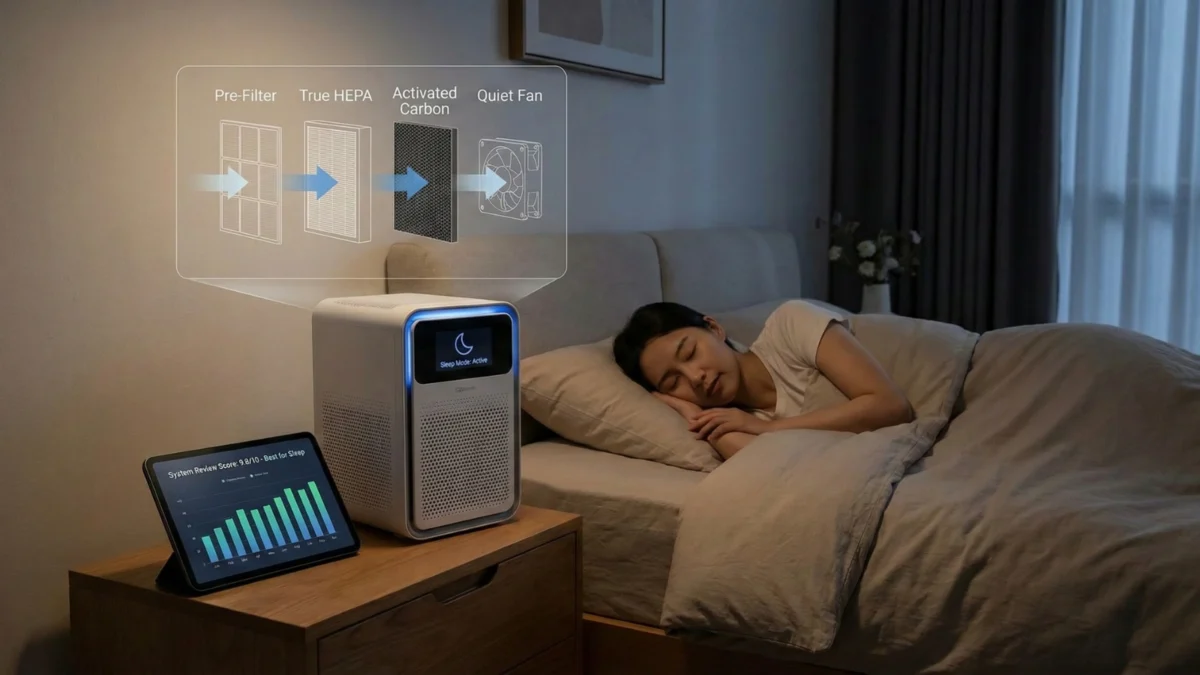
You spend roughly 7 to 9 hours in your bedroom every night. During that window, your body is not passive — it is executing its most energy-intensive repair processes: cellular autophagy, hormonal resetting, lymphatic drainage, and the glymphatic system’s clearance of neurotoxic waste from the brain. These processes require sleep to be deep, uninterrupted, and sustained through full REM and slow-wave cycles.
Air quality disrupts this in two ways that most people do not connect to sleep quality.
The first is particulate load. PM2.5 particles — the fine particulate matter under 2.5 microns that HEPA filters are specifically designed to capture — are small enough to cross the alveolar membrane in your lungs and enter systemic circulation. At elevated PM2.5 concentrations, your immune system activates a low-grade inflammatory response even during sleep. That inflammatory response competes with recovery. It fragments sleep architecture. It reduces the proportion of time spent in slow-wave sleep — the stage where growth hormone is released and tissue repair is most active. The EPA has linked chronic PM2.5 exposure to cardiovascular disease, cognitive decline, and reduced immune function. Your bedroom, where windows are often closed overnight and the door seals the space, is where that concentration accumulates unless actively cleared.
The second is VOCs (volatile organic compounds). Bedroom furniture, mattresses, carpets, and bedding all off-gas VOCs — particularly in newer homes or after new furniture purchases. Formaldehyde, benzene, and acetaldehyde are among the most common. Many are classified as probable carcinogens at chronic low-level exposure. A HEPA filter alone does not capture VOCs — they require an activated carbon layer. This is why filter type matters for bedroom use specifically, and why the presence or absence of activated carbon is a non-negotiable spec to check before buying.
The third factor — which almost no air purifier guide addresses — is CO₂ accumulation overnight. In a closed bedroom with one or two sleepers, CO₂ levels routinely rise from ambient outdoor levels of 400 ppm to over 1,200 ppm by morning. Research from the Harvard T.H. Chan School of Public Health found that CO₂ above 1,000 ppm correlates with measurable decline in cognitive function the following day — specifically in decision-making and focus. An air purifier does not remove CO₂ (that requires ventilation), but this context matters: if you are also running your bedroom with a slightly cracked window to manage CO₂, your HEPA purifier needs to compensate for the particulates that come through that opening.
The bottom line: a bedroom air purifier is not a comfort accessory. It is infrastructure for the 8 hours your body uses to maintain itself. Choosing the wrong one — or placing it incorrectly, or running it at the wrong speed — costs you measurable recovery quality every single night.
What to Look For in the Best HEPA Air Purifier for Bedroom Sleep
Most buyers get lost in marketing claims. Here are the five numbers that determine whether a purifier will actually perform in your bedroom — explained plainly.
What Is CADR and How Much Do You Need for Your Bedroom?
CADR stands for Clean Air Delivery Rate. It is measured in cubic feet per minute (CFM) and tells you how much filtered air the purifier delivers per minute at its highest speed. It is independently verified by AHAM (Association of Home Appliance Manufacturers) — making it the only standardized, third-party performance metric in this category. Ignore any claim not backed by an AHAM-verified CADR number.
To size correctly for your bedroom, use this formula: multiply your room’s square footage by the ceiling height (typically 8 feet) to get cubic feet, then divide by 60 to find the minimum CADR you need for 4 air changes per hour — the standard recommended for allergy and asthma sufferers.
For a standard 200 sq ft bedroom with 8-foot ceilings: 200 × 8 = 1,600 cubic feet ÷ 60 = minimum CADR of 27 CFM for one air change per hour. Multiply by 4 for the 4-ACH standard: you need at least 107 CFM for a 200 sq ft bedroom. For a 350 sq ft master bedroom: you need at least 187 CFM. Every purifier in this guide exceeds those thresholds comfortably — but coverage claims matter when choosing between them.
What Noise Level Is Actually Acceptable for Sleep?
The CDC recommends against prolonged exposure to sounds above 70 dB. For bedroom sleep, the relevant threshold is lower: research on sleep architecture indicates that sounds above 45 dB on a sustained basis increase arousal events and reduce the proportion of deep sleep, even in people who do not consciously wake up. The target for a bedroom air purifier running overnight is under 40 dB on your chosen sleep speed — ideally under 35 dB.
Most manufacturers publish dB specs at minimum and maximum speed. What they rarely clarify is the sound character — whether it is smooth white noise (fan airflow) or a higher-pitched mechanical hum. Smooth white noise at 40 dB is often less disruptive than a mechanical hum at 35 dB. Reviews and user reports are more reliable than specs alone for this distinction. All four picks in this guide have been selected partly for smooth, fan-like sound profiles rather than mechanical noise.
True HEPA vs H13 HEPA — Does the Difference Matter?
True HEPA is the marketing term for filters meeting the standard of capturing 99.97% of particles at 0.3 microns. H13 HEPA meets the same standard but is sometimes rated to capture more efficiently at very fine particle sizes (below 0.1 microns). For most bedrooms, True HEPA is sufficient. H13 becomes meaningful if you are dealing with wildfire smoke events, you live in a high-pollution urban environment, or you have severe respiratory conditions where ultrafine particle exposure is a clinical concern.
All four picks in this guide use True HEPA filters. The Levoit Core 400S uses a 3-stage system combining pre-filter, True HEPA, and activated carbon in a single integrated filter — which is the most relevant upgrade for bedrooms with VOC concerns.
Do You Need Activated Carbon for a Bedroom?
Yes — if any of the following apply: your bedroom has new furniture or mattress purchased within the last 2 years, you have hardwood or laminate flooring installed within the last 5 years, you use scented candles or diffusers, you have a gas appliance anywhere in the home, or you live in an urban area with traffic pollution infiltration. Activated carbon captures VOCs that HEPA cannot — it is a chemical adsorption layer, not a physical barrier. The trade-off is that carbon filters exhaust faster than HEPA filters and must be replaced more frequently. Factor carbon filter replacement cost into your total cost of ownership calculation before buying.
Can You Run It All Night? (Energy and Display Brightness)
A bedroom air purifier that runs intermittently provides inconsistent protection — particulate levels rise during the off periods. The best approach is continuous low-speed operation overnight. For this to be sustainable, the unit must meet two criteria: it must draw low enough wattage to be cost-effective at 8 hours per night, and it must have the ability to fully dim or turn off its display LEDs.
LED displays that cannot be dimmed disrupt sleep by introducing light stimulus in a dark room — even low-intensity blue light suppresses melatonin production. This is an underreported failure point for bedroom air purifiers. Check before buying whether the display can be set to fully dark. Every pick in this guide has a display management option — either automatic darkness sensing, manual dimming, or full shutoff.
At average U.S. electricity rates of approximately $0.16 per kWh, running a 50-watt purifier for 8 hours costs roughly $0.064 per night — about $23 per year. Running it 24/7 costs approximately $70 per year in electricity. Both are low enough to make continuous operation the right default for anyone using a bedroom purifier for health rather than convenience.
The 4 Best HEPA Air Purifiers for Bedroom Sleep in 2026
These four picks cover every bedroom scenario from a 150 sq ft guest room to a 450 sq ft master suite. Each is selected for a specific role in the Total System Health sleep environment framework — not just overall performance scores.
Each model below qualifies as a contender for the best HEPA air purifier for bedroom sleep, but they serve very different sleeper profiles.
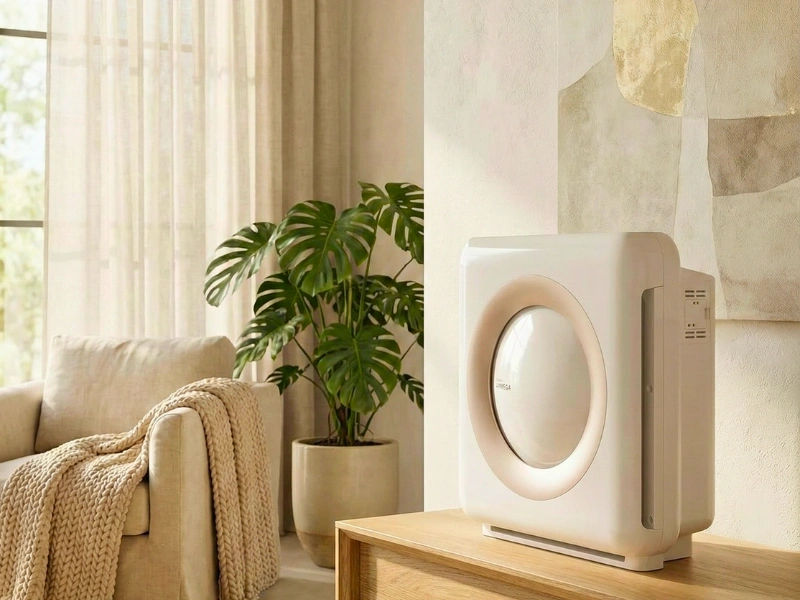
Pick #1: Coway Airmega AP-1512HH Mighty — Best Overall for Most Bedrooms
→ Check current Coway Airmega AP-1512HH Mighty price on Amazon
The Coway Airmega AP-1512HH Mighty has been the independently tested benchmark in this category for over a decade — and it still wins. It is not the newest, the quietest at maximum speed, or the most feature-rich. It is the most proven: independently verified CADR of 246 CFM for smoke, 240 CFM for dust, and 240 CFM for pollen, all confirmed by AHAM. In real-world testing by Modern Castle, it reduced PM2.5 particulate matter by 96% in a 320 sq ft room within 60 minutes at maximum speed. No competing unit at its price point has matched its consistency across this many independent evaluations.
For a bedroom, its most relevant specification is its low-speed noise floor: 24.4 dB — a level that most testers describe as essentially inaudible, indistinguishable from silence in a room with a closed door. This is not a manufacturer claim. It has been measured independently by multiple testing labs and confirmed in user reviews consistently over years of production. At this noise level, you can run the Coway on its lowest speed overnight without it competing with your sleep architecture in any meaningful way.
Its four-stage filtration system includes a washable pre-filter (captures large particles and extends HEPA filter life), an activated carbon filter (captures VOCs and odors), a True HEPA filter (captures 99.97% of particles at 0.3 microns), and an optional ionizer that can be switched off entirely. The ionizer is the one feature to disable for bedroom use — ionizers produce trace ozone as a byproduct, and while levels are within regulatory limits, there is no benefit to leaving it on overnight in a closed room.
Its air quality sensor and auto mode adjust fan speed based on detected particle levels in real time — meaning the unit will run quietly through the night and ramp up only if a trigger event (a partner getting up, a window opening, dust disturbance) raises particulate levels above threshold. This self-management removes the need to manually adjust settings overnight.
The most compelling case for the Coway in a Total System Health framework is its total cost of ownership. At approximately $0.07 per CFM per year — the lowest in this entire category — it is the most financially efficient air purification infrastructure you can put in a bedroom. Replacement filters run approximately $20–$25 per year at the recommended 6–12 month replacement interval, depending on usage and air quality in your area.
| Spec | Coway Airmega AP-1512HH Mighty |
|---|---|
| Price | ~$90–$110 |
| CADR (Smoke / Dust / Pollen) | 246 / 240 / 240 CFM (AHAM verified) |
| Room Coverage (4 ACH) | Up to 360 sq ft |
| Noise (Low / High) | 24.4 dB / 53.8 dB |
| Filter Type | Pre-filter + Activated Carbon + True HEPA + Optional Ionizer |
| Display Dimming | Partial — air quality LED cannot be fully disabled; tape workaround used by many |
| Auto Mode | Yes — air quality sensor driven |
| Sleep Mode | No dedicated sleep mode |
| Smart / App Control | No |
| Annual Filter Cost | ~$20–$25 |
| 5-Year Total Cost | ~$210–$235 (lowest in this comparison) |
| Energy Use | 4.8W (low) to 77W (max) |
| Weight | 12.3 lbs |
| Best For | Most bedrooms under 360 sq ft — proven performance, lowest lifetime cost |

- Coway Mighty (AP-1512HH) is designed to accommodate room sizes up to 361 sq. ft (CADR: Dust 246 / Pollen 240 / Smoke 233…
- 4 Stage Filtration System (Pre-filter, Deodorization filter, True HEPA filter, Vital Ion) captures and reduces up to 99….
- Coway Mighty pollution sensor communicates indoor air quality in real-time. The brightly colored LED lets you know how c…
One thing to know: The Coway’s air quality indicator LED — the circular ring on the control panel — cannot be fully disabled. It cycles through colors based on detected air quality and remains on during operation. In a completely dark bedroom this is visible. The standard workaround is black electrical tape over the LED, which most users adopt within the first week. If a fully dark bedroom is non-negotiable for you, the Blueair 311i Max (Pick #4) or the Winix 5510 (Pick #2) with its sleep mode are better options.
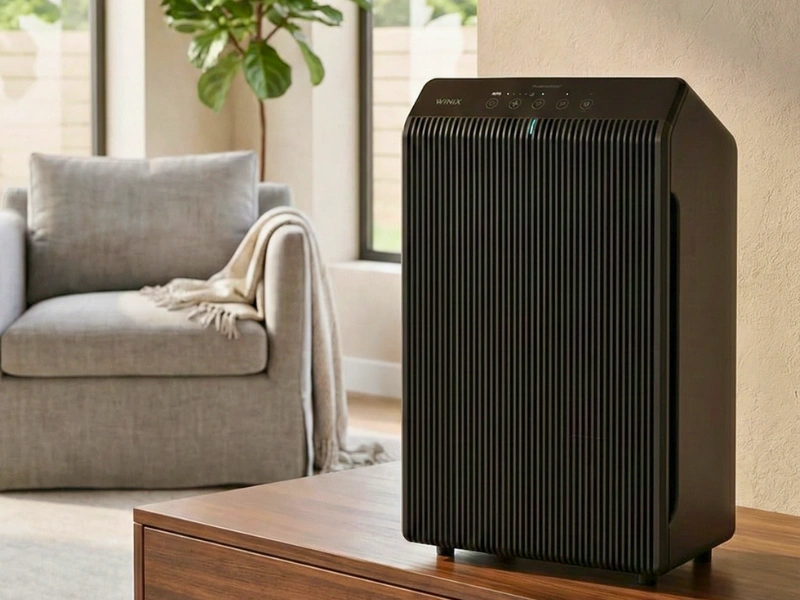
Pick #2: Winix 5510 — Best for Sleep-Specific Features
→ Check current Winix 5510 price on Amazon
Where the Coway is the proven workhorse, the Winix 5510 is specifically engineered for the bedroom environment in ways that its competitors are not. Its most important differentiator for sleep is its dedicated sleep mode: when the room darkens, the Winix’s ambient light sensor detects the change, automatically drops to its lowest fan speed, and dims all indicator lights to near-invisible levels. For light sleepers who are disrupted by both sound and light stimulus, this single feature changes the entire overnight experience.
Its 3-stage filtration includes a washable pre-filter, a granular activated carbon filter for odors and VOCs, and a True HEPA filter — with an optional PlasmaWave ionizer that, like the Coway’s ionizer, should be switched off for bedroom overnight use. Its AHAM-verified coverage rating of 392 sq ft at 4 ACH exceeds the Coway’s 360 sq ft rating — making it the stronger option for larger bedrooms in this price tier.
The Winix also includes a remote control — a meaningful quality-of-life feature for a bedroom unit. Being able to adjust fan speed or switch modes without getting out of bed or opening an app removes the friction that causes most people to set and forget rather than optimize. For bedroom use specifically, where you may want to run the unit on high for 20 minutes before sleep and then drop it to low before you fall asleep, the remote makes that protocol effortless.
Its air quality sensor is one of the most sensitive in this price range, capable of detecting fine particulate increases from sources like walking across carpet, changing bedding, or a pet entering the room. In auto mode this sensor drives real-time fan adjustments, keeping the bedroom air continuously at optimum quality without manual intervention.
| Spec | Winix 5510 |
|---|---|
| Price | ~$170–$200 |
| CADR (Smoke / Dust / Pollen) | AHAM Verified at 392 sq ft |
| Room Coverage (4 ACH) | Up to 392 sq ft |
| Noise (Low / High) | ~28 dB / ~60 dB |
| Filter Type | Pre-filter (washable) + Activated Carbon + True HEPA + PlasmaWave (optional) |
| Display Dimming | Sleep mode auto-dims all LEDs — one sleep indicator LED remains on |
| Auto Mode | Yes — air quality sensor driven |
| Sleep Mode | ✅ Yes — light-sensing, auto fan drop + near-full LED dim |
| Smart / App Control | ✅ Yes — Winix app |
| Remote Control | ✅ Yes |
| Annual Filter Cost | ~$30–$50 |
| 5-Year Total Cost | ~$320–$450 |
| Energy Use | ~7W (low) to 70W (max) |
| Weight | 15.4 lbs |
| Best For | Light sleepers, automated overnight operation, app control, bedrooms up to 392 sq ft |

- 𝐀𝐇𝐀𝐌 𝐕𝐞𝐫𝐢𝐟𝐢𝐝𝐞 𝐚𝐭 𝟑92 𝐬𝐪 𝐟𝐭.: Also cleans rooms up to 1,882 sq ft in 1 hour (941 sq ft in 30 minutes, 627 sq ft in 20 min…
- 𝐖𝐢𝐧𝐢𝐱 𝐓𝐫𝐮𝐞 𝐇𝐄𝐏𝐀: Captures 99.99%* of airborne allergens including pollen, dust, smoke, and pet dander, as small as 0.01 …
- 𝐀𝐝𝐯𝐚𝐧𝐜𝐞𝐝 𝐎𝐝𝐨𝐫 𝐂𝐨𝐧𝐭𝐫𝐨𝐥 𝐂𝐚𝐫𝐛𝐨𝐧 𝐅𝐢𝐥𝐭𝐞𝐫: Reduces VOCs and household odors from cooking, pets, and smoke. It is designed to c…
One thing to know: The Winix sleep mode leaves one LED on — the moon-and-stars sleep mode indicator — which cannot be disabled while sleep mode is active. It is low-intensity and white, not blue, making it significantly less melatonin-disruptive than a color-changing air quality ring. Most users report it is not visible from a bed positioned more than 4 feet from the unit.
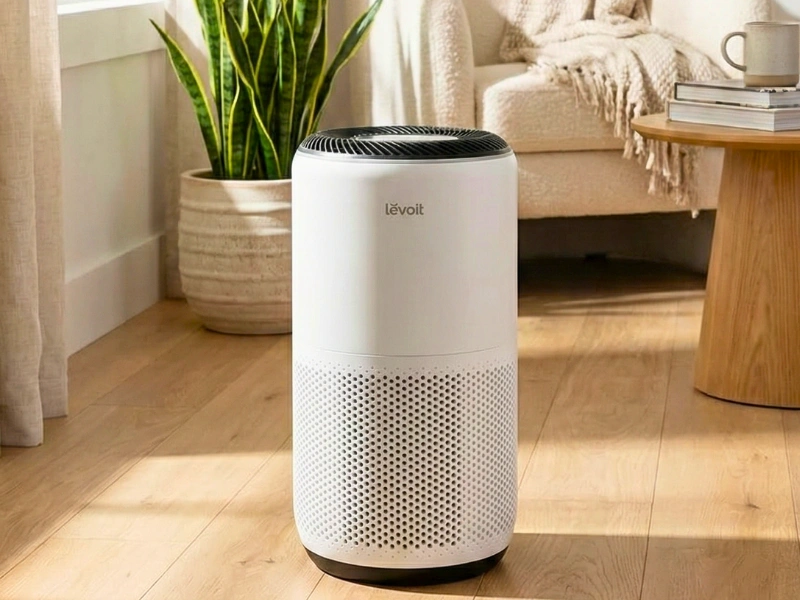
Pick #3: Levoit Core 400S — Best for VOCs and Smart Control
→ Check current Levoit Core 400S price on Amazon
The Levoit Core 400S is the pick for bedrooms where VOC load is a specific concern and smart home integration matters. Its 3-stage filtration system — pre-filter, True HEPA, and a custom high-efficiency activated carbon filter — handles both particulate and chemical contamination in a single cylindrical unit. Its CADR of approximately 260 CFM supports rooms up to 400 sq ft on the 4-ACH standard, making it the most capable purifier in this guide for larger bedrooms or rooms with moderate-to-high VOC sources.
The smart functionality via the VeSync app is genuinely useful for a bedroom application rather than just a marketing feature. The app allows you to set a sleep schedule — for example, high speed from 9:30 PM to 10 PM, then automatic drop to sleep speed from 10 PM to 6 AM — without needing to interact with the unit at all. It also provides real-time air quality data including PM2.5 readings, AQI estimates, and filter life percentage. For anyone managing a health-optimized bedroom environment, this data closes the feedback loop: you can see whether your purifier is actually maintaining the particulate levels you are targeting.
Its noise profile on sleep speed is notably smooth — reported consistently at 24–27 dB on the lowest setting, with a fan-airflow character that many users describe as sleep-positive white noise rather than mechanical interference. The display can be fully disabled through the app or by holding the display button, producing a completely dark unit during sleep hours.
The Levoit’s one trade-off relative to the Coway and Winix is annual filter cost. Its integrated 3-in-1 filter replacement runs approximately $35–$50 per filter, with a recommended 6–8 month replacement interval depending on air quality. This makes its 5-year total cost higher than the Coway despite a similar purchase price — a factor worth calculating for your specific budget before buying.
| Spec | Levoit Core 400S |
|---|---|
| Price | ~$150–$170 |
| CADR | ~260 CFM |
| Room Coverage (4 ACH) | Up to 403 sq ft |
| Noise (Low / High) | 24–27 dB / ~52 dB |
| Filter Type | Pre-filter + True HEPA + High-Efficiency Activated Carbon (3-in-1 integrated) |
| Display Dimming | ✅ Full display shutoff — completely dark in sleep mode |
| Auto Mode | ✅ Yes — air quality sensor driven |
| Sleep Mode | ✅ Yes — app-scheduled or manual |
| Smart / App Control | ✅ Yes — VeSync app, Alexa + Google Assistant compatible |
| Annual Filter Cost | ~$35–$50 |
| 5-Year Total Cost | ~$325–$420 |
| Energy Use | ~3W (low) to 38W (max) — most energy efficient in this guide |
| Weight | 10.8 lbs |
| Best For | Bedrooms with new furniture, VOC concerns, or smart home setups; rooms up to 400 sq ft |

- 𝐖𝐇𝐘 𝐂𝐇𝐎𝐎𝐒𝐄 𝐀𝐇𝐀𝐌 𝐕𝐄𝐑𝐈𝐅𝐈𝐃𝐄 𝐀𝐈𝐑 𝐏𝐔𝐑𝐈𝐅𝐈𝐄𝐑𝐒: AHAM (Association of Home Appliance Manufacturers) is an ANSI-accredited organiz…
- 𝐀𝐇𝐀𝐌 𝐕𝐄𝐑𝐈𝐅𝐈𝐃𝐄 & 𝐓𝐑𝐔𝐒𝐓𝐄𝐃 𝐁𝐘 𝐄𝐗𝐏𝐄𝐑𝐓𝐒: Certified by the Association of Home Appliance Manufacturers (AHAM), the Core 400S-P…
- 𝐇𝐈𝐆𝐇-𝐄𝐅𝐅𝐈𝐂𝐈𝐄𝐍𝐂𝐘 𝐀𝐈𝐑 𝐏𝐔𝐑𝐈𝐅𝐈𝐂𝐀𝐓𝐈𝐎𝐍 𝐅𝐎𝐑 𝐋𝐀𝐑𝐆𝐄 𝐑𝐎𝐎𝐌𝐒: The LEVOIT Core 400S-P Air Purifier is designed for powerful whole-roo…
One thing to know: The Levoit Core 400S uses a 2.4 GHz Wi-Fi only — it does not support 5 GHz networks. If your router broadcasts only on 5 GHz or you use a newer mesh network that does not have a 2.4 GHz band enabled, you will not be able to connect the smart features. The purifier still functions fully as a HEPA unit without the app, but the scheduling and monitoring features will be unavailable.
Pick #4: Blueair Blue Pure 311i Max — Best for Light Sleepers and Near-Silence
→ Check current Blueair Blue Pure 311i Max price on Amazon
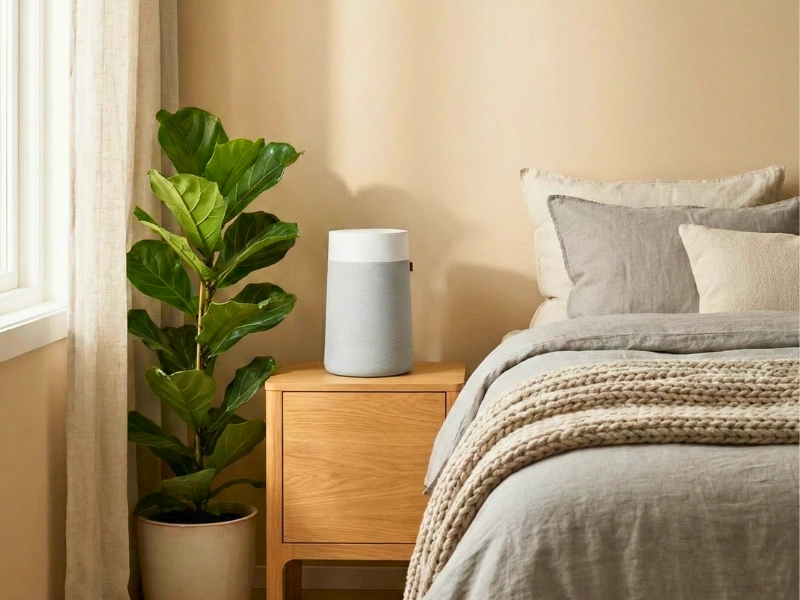
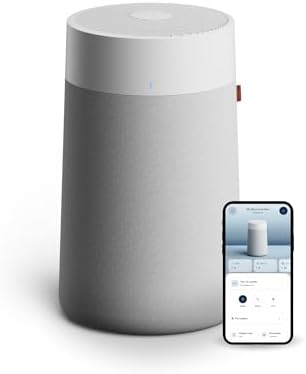
The Blueair Blue Pure 311i Max is the premium pick for one specific type of sleeper: the person for whom noise is the primary barrier to deep, uninterrupted rest. On its sleep mode setting, the 311i Max operates at 19 dB — a level that is, by any meaningful measurement, inaudible. For reference, 20 dB is roughly the acoustic level of a recording studio or a whisper from 5 feet away. Below 25 dB, most humans cannot distinguish the sound from ambient room noise. The 311i Max sits comfortably below that threshold in sleep mode while still delivering a CADR of 365 CFM — the highest in this guide.
That combination — highest CADR, lowest noise floor — comes from Blueair’s proprietary HEPASilent technology, which uses both mechanical filtration and electrostatic enhancement to capture particles with less airflow resistance. Less resistance means the fan motor works less hard to push air through the filter, which translates directly into lower operating noise at any given fan speed. The trade-off is a slightly higher purchase price and annual filter cost relative to the Coway and Winix — but for the light sleeper who has tried other purifiers and found them too loud, this is not an upgrade, it is a solution.
Its room coverage of up to 439 sq ft at 4 ACH makes it the right choice for master bedrooms or any bedroom that has felt undersized for a standard-range purifier. Its Blueair app provides scheduling, auto mode control, and geo-fencing — the ability to have the purifier ramp up to high speed 30 minutes before you arrive home so the bedroom air is already clean when you enter. Its washable fabric pre-filter comes in multiple colors (a detail that matters if your bedroom aesthetic is important to you), and the main HEPA filter requires replacement approximately once per year.
| Spec | Blueair Blue Pure 311i Max |
|---|---|
| Price | ~$230–$250 |
| CADR (Pollen) | 365 CFM (highest in this guide) |
| Room Coverage (4 ACH) | Up to 439 sq ft |
| Noise (Sleep Mode / High) | 19 dB / 48 dB |
| Filter Type | Washable fabric pre-filter + HEPASilent combined HEPA + electrostatic |
| Display Dimming | ✅ Full auto-dim in sleep mode |
| Auto Mode | ✅ Yes |
| Sleep Mode | ✅ Yes — 19 dB, full LED dim |
| Smart / App Control | ✅ Yes — Blueair app, geo-fencing, scheduling |
| Annual Filter Cost | ~$50–$70 |
| 5-Year Total Cost | ~$480–$600 |
| Energy Use | ~3W (low) to 46W (max) |
| Weight | 8.8 lbs — lightest in this guide |
| Best For | Light sleepers, large bedrooms up to 439 sq ft, anyone for whom noise is the primary concern |
- BLUEAIR’S TOP-PERFORMING AIR PURIFIER LINE: Blue family’s new Pure Max series with our proprietary HEPASilent performanc…
- LET’S CLEAR THE AIR QUIETER: Quiet Mark certified (23-50dB); Cleans up to 1,858 sqft space in 60 min, 929sqft in 30min o…
- LET’S CLEAR THE AIR FASTER: HEPASilent dual filtration technology delivers more clean air faster and uses less noise and…
One thing to know: Blueair’s HEPASilent technology uses a mild electrostatic charge to enhance particle capture. This produces no measurable ozone and has been independently verified as safe for bedroom use. However, the technology requires the filter to remain dry — do not place the unit in a bathroom or high-humidity room where the filter could become damp, as this reduces filtration efficiency. For standard bedroom humidity levels (40–60% RH), it performs exactly as rated.
All 4 Picks Side by Side: The Complete Comparison Table
| Spec | Coway Mighty | Winix 5510 | Levoit Core 400S | Blueair 311i Max |
|---|---|---|---|---|
| Price | ~$90–$110 | ~$170–$200 | ~$150–$170 | ~$230–$250 |
| CADR (CFM) | 246 | 392 sq ft AHAM | ~260 | 365 |
| Room Coverage (4 ACH) | 360 sq ft | 392 sq ft | 403 sq ft | 439 sq ft |
| Noise on Sleep Speed | 24.4 dB | ~28 dB | 24–27 dB | 19 dB |
| True HEPA | ✅ | ✅ | ✅ | ✅ |
| Activated Carbon | ✅ | ✅ | ✅ (high-efficiency) | ⚠️ Limited |
| VOC Capture | Moderate | Moderate | Strong | Weak |
| Full Display Shutoff | ❌ (tape workaround) | ⚠️ (1 LED remains) | ✅ | ✅ |
| Sleep Mode | ❌ | ✅ Auto-sensing | ✅ App-scheduled | ✅ Auto-sensing |
| Auto Mode | ✅ | ✅ | ✅ | ✅ |
| Smart / App | ❌ | ✅ Winix app | ✅ VeSync | ✅ Blueair app |
| Remote Control | ❌ | ✅ | ❌ | ❌ |
| AHAM Verified | ✅ | ✅ | ✅ | ✅ |
| Annual Filter Cost | ~$20–$25 | ~$30–$50 | ~$35–$50 | ~$50–$70 |
| Energy Use (Low/Max) | 4.8W / 77W | 7W / 70W | 3W / 38W | 3W / 46W |
| Weight | 12.3 lbs | 15.4 lbs | 10.8 lbs | 8.8 lbs |
| Best For | Most bedrooms, lowest cost | Light sleepers, sleep features, app control | VOCs, smart homes, larger rooms | Near-silence, large master bedrooms |
5-Year Total Cost of Ownership: The Number That Changes the Decision
Purchase price is the least important number in this comparison. A bedroom air purifier runs 8 hours per night minimum — more likely 24 hours a day if you are serious about continuous air quality management. At that usage level, filter replacement cost and electricity draw compound over years in ways that significantly change the true cost of each unit.
This table uses the following assumptions: 24/7 operation at average speed, $0.16/kWh electricity rate, and manufacturer-recommended filter replacement intervals.
| Cost Factor | Coway Mighty | Winix 5510 | Levoit Core 400S | Blueair 311i Max |
|---|---|---|---|---|
| Purchase Price | ~$100 | ~$185 | ~$160 | ~$240 |
| Annual Filter Cost | ~$22 | ~$40 | ~$43 | ~$60 |
| Annual Electricity Cost | ~$28 | ~$26 | ~$17 | ~$18 |
| Total Annual Running Cost | ~$50 | ~$66 | ~$60 | ~$78 |
| 5-Year Total Cost | ~$350 | ~$515 | ~$460 | ~$630 |
| Cost Per CFM Per Year | $0.07 | $0.14 | $0.11 | $0.13 |
What this table shows is that the Coway Airmega Mighty is not just the cheapest to buy — it is the cheapest to own by a significant margin over five years. At $350 total versus the Blueair’s $630, the Coway saves you $280 over the same period while delivering nearly identical CADR performance for rooms under 360 sq ft. The Levoit’s energy efficiency (only 3W on low — less than an LED bulb) partially closes the gap with the Blueair despite its higher filter cost. The Winix lands in the middle on cost but delivers the strongest sleep-specific feature set at that price tier.
The decision framework: if your bedroom is under 360 sq ft and budget is a factor, the Coway is the right answer and the math is clear. If near-silence or smart scheduling would meaningfully change how consistently you use the unit, the premium for the Blueair or Levoit is justified — because a purifier you run every night outperforms a cheaper one you occasionally switch off.
Where to Place Your Bedroom Air Purifier: 4 Rules That Affect Performance
Even the best HEPA air purifier for bedroom sleep will underperform if placed too close to walls or outside the breathing zone. Placement is the variable most buyers ignore after purchase, and it meaningfully affects how well your purifier actually cleans the air you breathe while sleeping.
Rule 1 — Elevate it. Place the unit 2–3 feet off the floor, not directly on the ground. Fine particulate matter (PM2.5) and VOCs exist throughout the air column, but the breathing zone while sleeping — at pillow height — is where filtration efficiency matters most. Elevation brings the unit’s intake and output closer to that zone. A nightstand, dresser, or dedicated shelf works. Do not place it directly on carpet, which restricts airflow to the base intake.
Rule 2 — Keep it away from walls and corners. All four purifiers in this guide use 360-degree air intake or multi-directional intake. Placing the unit flush against a wall cuts off intake on one side, reducing effective CADR by as much as 20–30%. Keep at least 12–18 inches of clearance on all sides.
Rule 3 — Position the output toward your breathing zone. The clean air outlet — typically the top or a directional vent — should face toward where your head rests, not toward the wall or window. This ensures the highest-quality filtered air is delivered into your breathing zone first before mixing with room air.
Rule 4 — Do not place it directly next to the bed. Within 18 inches, even a 24 dB unit creates a localized sound pressure that is more noticeable than the same unit at 4–6 feet. The optimal placement for most standard bedrooms is 4–6 feet from the head of the bed, elevated on a surface at mattress height or slightly above, with the output directed toward the bed.
For open-concept bedrooms or rooms over 400 sq ft with high ceilings, a two-unit strategy — one on each side of the room — running simultaneously at lower speeds will outperform a single unit running at maximum speed, while producing less total noise and lower peak electricity draw.
Which One Is Right for You? The Verdict by Sleeper Type
There is no single best HEPA air purifier for bedroom sleep for everyone — the right choice depends on room size, noise sensitivity, VOC exposure, and automation needs.
You have a standard bedroom (under 300 sq ft), you want the best value, and noise is not your primary concern: The Coway Airmega AP-1512HH Mighty is your answer. It has the lowest purchase price, the lowest 5-year cost, AHAM-verified performance, and a noise floor of 24.4 dB that is genuinely quiet. The LED workaround is a minor inconvenience that most users solve in minutes. Nothing in this category beats its cost-per-CFM performance.
You are a light sleeper and any noise or light in the bedroom affects your sleep quality: The Blueair Blue Pure 311i Max is the only purifier in this guide that operates at 19 dB in sleep mode — below the threshold of audibility for most people in a standard bedroom. Its full auto-dimming in sleep mode and highest CADR in this group make it the correct choice if noise sensitivity is your controlling variable, regardless of price.
You want the purifier to manage itself overnight without any manual input: The Winix 5510 is purpose-built for this. Its light-sensing sleep mode activates automatically when the room darkens, drops to lowest fan speed, and dims its LEDs without any app, schedule, or button press required. The remote control adds the ability to fine-tune from bed without getting up. For anyone who wants a set-and-forget bedroom system, the Winix is the most operationally effortless pick.
Your bedroom has new furniture, new flooring, or you have VOC concerns: The Levoit Core 400S is the only pick in this guide with a high-efficiency activated carbon layer specifically designed for chemical capture alongside HEPA particulate filtration. Its smart app allows you to schedule aggressive purification during the day when you are out — when off-gassing from furniture is highest — and shift to quiet sleep mode automatically by bedtime. It is also the most energy-efficient unit at 3W on low, making 24/7 operation the lowest ongoing electricity cost in this group aside from the Blueair.
You have severe allergies or asthma and sleep quality is directly tied to your health outcomes: Run the Coway or Winix on their second-highest speed for 30 minutes before bed to aggressively reduce the room’s particulate concentration, then drop to low speed before you fall asleep. This two-phase protocol — pre-sleep high-speed purge followed by quiet overnight maintenance — delivers measurably cleaner sleep air than running at low speed all evening. Both units support this protocol with their auto or manual speed controls.
Your bedroom is a master suite over 400 sq ft: Either the Blueair 311i Max (439 sq ft coverage at 4 ACH) or the Levoit Core 400S (403 sq ft) are the appropriate choices for this room size. The Coway and Winix are rated to 360 sq ft — they will still provide benefit in a larger room but will not achieve the 4 air changes per hour standard that delivers optimal particulate reduction for allergy or health-priority use.
Choosing the best HEPA air purifier for bedroom sleep is ultimately about consistency: the unit you can run every night, all night, without disruption.
Frequently Asked Questions: Best HEPA Air Purifier for Bedroom Sleep
Is it safe to run a HEPA air purifier all night in a bedroom?
Yes — running a True HEPA air purifier continuously overnight is not only safe but is the recommended operating protocol for health-optimized bedroom environments. HEPA filters are passive mechanical barriers: they capture particles through a fibrous filter medium and do not emit anything into the air. The one exception is ionizers and UV-C lamps, which some purifiers include as optional add-on features. Ionizers produce trace ozone as a byproduct, and UV-C lamps can produce ozone if they emit wavelengths below 254nm. For bedroom overnight use, the correct protocol is to disable the ionizer or UV-C feature if your purifier has one — then run the HEPA and carbon filtration stages continuously. All four purifiers in this guide allow the ionizer to be switched off independently of the main HEPA filtration, or do not include an ionizer at all (Levoit Core 400S and Blueair 311i Max). Running the fan continuously at low speed is the lowest-noise, most energy-efficient, and most effective protocol for maintaining consistent bedroom air quality through the night.
What CADR do I need for my bedroom size?
Use this quick reference to match your bedroom’s square footage to the minimum CADR you need for 4 air changes per hour — the standard recommended for allergy and asthma management:
| Bedroom Size | Minimum CADR for 4 ACH (8-ft ceiling) |
|---|---|
| 150 sq ft (small bedroom) | 80 CFM |
| 200 sq ft (standard bedroom) | 107 CFM |
| 250 sq ft (medium bedroom) | 133 CFM |
| 300 sq ft (large bedroom) | 160 CFM |
| 360 sq ft (master bedroom) | 192 CFM |
| 400 sq ft (large master) | 213 CFM |
| 450 sq ft (suite) | 240 CFM |
All four purifiers in this guide exceed the 192 CFM threshold needed for a 360 sq ft bedroom. The Coway and Winix are best sized for rooms up to 360 sq ft. The Levoit Core 400S covers up to 403 sq ft and the Blueair 311i Max covers up to 439 sq ft — both appropriate for larger master suites. If your bedroom exceeds 450 sq ft or has ceilings above 9 feet, a two-unit strategy with both units running at moderate speed will outperform a single large unit at maximum speed, while producing less noise and more consistent air distribution across the room.
Do air purifiers help with sleep quality?
The evidence is direct and measurable, though still emerging as a body of research. A randomized controlled trial published in peer-reviewed literature found that participants who slept with a HEPA air purifier running in their bedroom for two weeks averaged 12 additional minutes of sleep per night compared to those who did not — a clinically meaningful improvement at population scale. The proposed mechanism is reduction in PM2.5 particulate matter, which at elevated concentrations triggers a low-grade systemic inflammatory response even during sleep. That inflammatory load competes with the recovery processes the body executes during slow-wave and REM sleep — specifically cellular repair, hormonal resetting, and glymphatic clearance of neurotoxic waste from the brain.
Separately, the removal of VOCs through activated carbon filtration reduces the chemical exposure load during the hours your respiratory system is most continuously active. And for allergy sufferers specifically, reducing overnight pollen, dust mite particle, and pet dander concentrations measurably reduces the nasal congestion and micro-arousal events that fragment sleep architecture without causing full waking. The mechanism is not complex: cleaner air means less immune activation, less immune activation means more recovery capacity, more recovery capacity means higher sleep quality as measured by both subjective experience and objective markers like next-day cognitive performance and morning HRV.
What is the difference between True HEPA and H13 HEPA for bedroom use?
True HEPA is the filtration standard requiring capture of 99.97% of particles at 0.3 microns — the particle size at which HEPA filters are least efficient, called the Most Penetrating Particle Size (MPPS). At both larger and smaller particle sizes, True HEPA filters actually perform better than 99.97%. H13 HEPA refers to a European classification grade that meets or exceeds the True HEPA standard, often with higher tested efficiency at ultrafine particle sizes below 0.1 microns — the range that includes the smallest combustion particles, some viral particles, and ultrafine PM from traffic pollution.
For most bedrooms with standard household air quality concerns — dust, pollen, pet dander, mold spores, skin cells — True HEPA is fully sufficient. The practical difference between True HEPA and H13 is most meaningful in three specific scenarios: you live in a high-wildfire-risk area where ultrafine combustion particles are a seasonal concern, you live within a quarter mile of a major highway or industrial facility with continuous ultrafine PM infiltration, or you have a diagnosed respiratory condition where your physician has specifically identified ultrafine particle exposure as a clinical trigger. In all other bedroom use cases, True HEPA — which all four picks in this guide provide — performs to the standard that independent research has shown to improve sleep air quality and reduce particulate-driven inflammation.
Should I get an air purifier or a dehumidifier for my bedroom?
These two devices address different biological problems and in a health-optimized bedroom environment, they are not substitutes — they are partners. A HEPA air purifier removes particulate matter, allergens, and VOCs from the air. A dehumidifier removes excess moisture. The reason both matter for sleep quality is that humidity is itself a vector for the biological threats your air purifier is trying to eliminate: dust mites thrive above 50% relative humidity, mold begins colonizing surfaces above 60% RH, and high humidity significantly increases the airborne concentration of VOCs off-gassing from furniture and building materials. Running a HEPA air purifier in a bedroom with 65–70% humidity is less effective than running the same purifier in a bedroom maintained at 45–50% RH — because humidity creates the conditions in which your particulate sources reproduce and re-contaminate the air.
The EPA and ASHRAE both target 30–50% relative humidity as the range that minimizes mold, dust mite, and pathogen viability while keeping respiratory membranes adequately hydrated. If your bedroom humidity runs above 55% seasonally or year-round, a dehumidifier working alongside your HEPA purifier creates a meaningfully cleaner sleep environment than either device alone. For a full breakdown of how to manage bedroom humidity as part of a complete indoor air quality system, see our guide to the best dehumidifiers for bedroom use.
How often do I need to replace the filter in a bedroom air purifier?
Filter replacement intervals depend on three variables: the volume of air the purifier is processing, the particle load in your specific environment, and the size of the filter itself. Manufacturer recommendations are baseline estimates built for average use conditions — in practice, bedroom air purifiers running 24/7 in homes with pets, high dust load, or above-average outdoor pollution will exhaust filters faster than the stated interval.
A practical replacement schedule for continuous 24/7 bedroom operation: pre-filters (washable) should be rinsed monthly to prevent restriction of airflow to the main HEPA filter. HEPA filters in continuous bedroom use typically need replacement every 6–10 months rather than the 12-month interval listed on the packaging. Activated carbon filters exhaust faster than HEPA filters — carbon is a finite adsorption medium, and once its binding sites are saturated, it stops capturing VOCs even if it still looks intact. For bedrooms with new furniture or high VOC load, carbon filter replacement at 4–6 months is appropriate even if the HEPA layer still has life remaining. Most integrated 3-in-1 filters (like the Levoit Core 400S design) replace both layers simultaneously on the same schedule, which simplifies maintenance at the cost of some filter economy.
The simplest monitoring approach: use the filter life indicator on units that have one (Coway, Levoit, Winix, and Blueair all include this), but treat it as a minimum threshold rather than an exact replacement date. If you notice reduced airflow at the same fan speed setting, visible darkening of the pre-filter that does not clear after washing, or increased allergy symptoms after a period of stable relief, those are the operational signals that a filter change is overdue regardless of what the indicator shows.
How Your Bedroom Air Purifier Fits the Total System Health Sleep Environment
A bedroom HEPA air purifier is the active filtration layer of a three-part sleep environment system. Understanding where it sits — and what it cannot do alone — determines how much benefit you actually extract from it.
Layer 1 — Source Reduction: The most effective way to reduce the load on your HEPA purifier is to reduce the sources of particulate and chemical contamination before they enter the air. This means low-VOC furniture and building materials where possible, MERV-13 or higher filters in your HVAC system to capture particles before they circulate through the home, and regular vacuuming with a HEPA-filtered vacuum to prevent settled particles from becoming airborne. For a complete guide to reducing indoor particulate and chemical sources before they reach your purifier, see our article on how to reduce indoor air pollutants naturally.
Layer 2 — Humidity Control: As covered in the FAQ above, a HEPA purifier working in a humidity-controlled bedroom is measurably more effective than the same purifier in an uncontrolled humidity environment. Dust mites, mold, and VOC off-gassing rates all increase with humidity above 50% RH. Maintaining 40–50% RH in your bedroom removes the biological conditions that continuously reintroduce particulate load into the air your purifier is trying to clean. See our full breakdown of when you need a whole-home dehumidifier vs a portable unit for guidance on matching dehumidification capacity to your bedroom environment.
Layer 3 — Active Filtration: This is where your HEPA air purifier operates — continuous removal of the particulate and chemical load that source reduction and humidity control did not eliminate. Sized correctly for your room, placed correctly relative to your breathing zone, and running continuously on a low-speed overnight protocol, a True HEPA purifier with activated carbon maintains the sleep environment standard that the research above links to measurably better sleep architecture, lower overnight inflammatory load, and improved next-day cognitive performance.
The three layers work as a system. Investing only in Layer 3 — buying a good purifier but ignoring humidity and source reduction — leaves the majority of the biological benefit on the table. Investing in all three, in sequence, is what a health-optimized bedroom environment actually looks like.
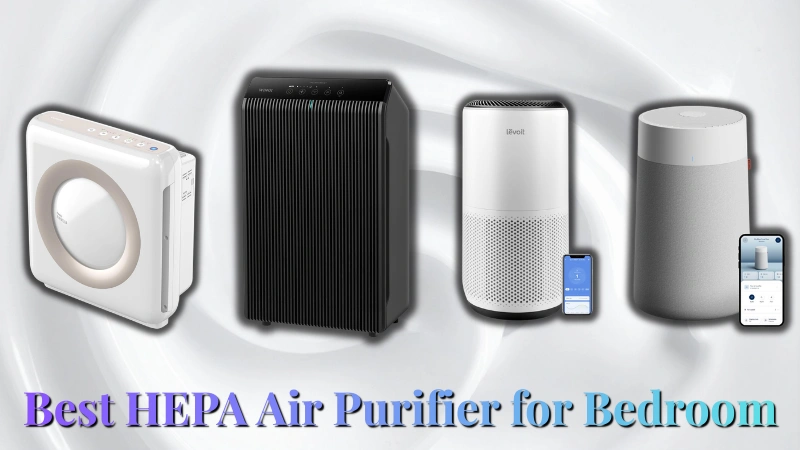
- Coway Airmega AP-1512HH Mighty — Best Overall
- Winix 5510 — Best for Sleep Features
- Levoit Core 400S — Best for VOCs and Smart Control
- Blueair Blue Pure 311i Max — Best for Near-Silence
This article is for informational purposes only and does not constitute medical advice. If you have a diagnosed respiratory condition, cardiovascular disease, or sleep disorder, consult your physician before making changes to your sleep environment. Individual responses to air quality improvements vary. Total System Health is a participant in the Amazon Services LLC Associates Program — affiliate links in this article support the site at no additional cost to you.