
Total System Health is reader‑supported. When you purchase through links on our site, we may earn an affiliate commission at no additional cost to you. For more details, please see our Privacy Policy.
Choosing between portable HEPA air purifiers vs whole-home filtration is not merely about selecting an appliance; it is a decision about your home’s environmental infrastructure. This choice centers on a fundamental tradeoff: do you invest in a centralized, whole-home system that operates as part of your building’s core functions, or do you deploy targeted, point-of-use devices for specific spaces? This analysis examines portable HEPA air purifiers and whole-home filtration systems through the lens of infrastructure, focusing on cumulative exposure, airflow mechanics, coverage scope, and long-term ownership.
Introduction: Portable HEPA Air Purifiers vs Whole-Home Filtration: Core System Differences
Indoor air is a continuous environmental exposure. The U.S. Environmental Protection Agency notes that concentrations of some pollutants can be two to five times higher indoors than outdoors, making the management of this environment a long-term consideration. Pollutants like fine particulate matter (PM2.5), allergens, and volatile organic compounds (VOCs) contribute to a cumulative load on the body over time. Addressing this is not about achieving instant, “clean” air but about systematically reducing the daily and lifetime dose of airborne contaminants. Therefore, selecting an air cleaning method is less about buying a product and more about integrating a layer of control into your living environment—a choice between a decentralized network of point solutions and a centralized utility.
Portable HEPA Air Purifiers: Strengths and Constraints
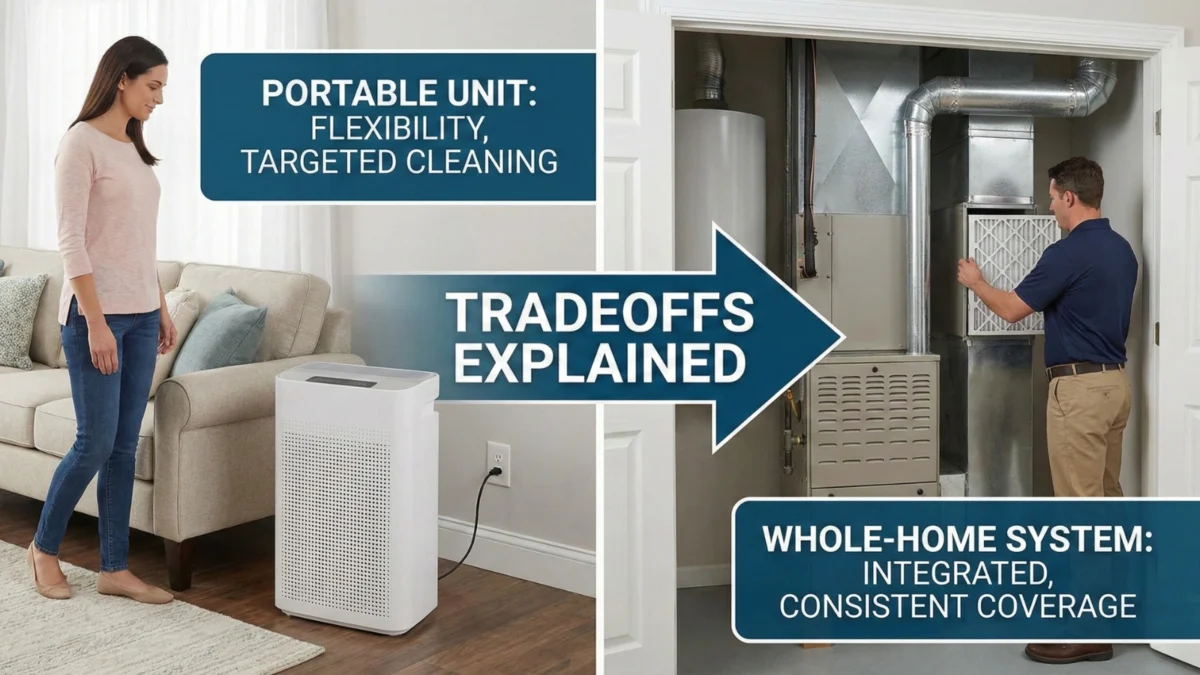
Portable HEPA air purifiers are point-of-use systems. They are standalone appliances designed to clean the air within a single, enclosed room by drawing air through a series of internal filters, most notably a High-Efficiency Particulate Air (HEPA) filter, which is certified to capture 99.97% of particles as small as 0.3 microns.
Strengths:
- Targeted and Flexible: They excel at creating clean air zones in specific rooms where people spend extended periods, such as bedrooms, nurseries, or home offices. Their portability allows them to be moved as needs change.
- Low Barrier to Entry: They require no renovation or professional installation—just an electrical outlet. This makes them the only viable option for renters or homes without forced-air HVAC systems.
- Advanced Sensing & Control: Many modern units feature air quality sensors, smart connectivity, and automatic modes that adjust fan speed in response to real-time pollution levels.
- Independent Operation: They function regardless of whether the home’s heating or cooling system is running, providing continuous local purification.
Constraints:
- Room-Limited Efficacy: Their effectiveness is confined by walls and doors. To clean multiple rooms, multiple units are required, which increases upfront costs, energy use, and maintenance points.
- Airflow Dependency: Performance is highly dependent on the unit’s Clean Air Delivery Rate (CADR) and its placement within the room. Obstructions or poor placement can create “dead zones” with less filtered air.
- Noise and Space: At higher fan speeds, some models can produce noticeable noise. They also occupy floor or shelf space, which can be a practical and aesthetic consideration.
Whole-Home Filtration Systems: Strengths and Constraints
Whole-home systems are infrastructure-level solutions. They are integrated directly into the existing ductwork of a forced-air HVAC system, filtering all air that circulates through the home’s central heating and cooling network. These systems often utilize high-MERV (Minimum Efficiency Reporting Value) pleated filters, dedicated HEPA filtration cabinets, or other in-duct technologies.
Strengths:
- Comprehensive, Passive Coverage: They provide baseline air cleaning to every room connected to the ductwork, treating the home as a single integrated environment. This passive, whole-house approach is seamless and out of sight.
- Quiet and Unobtrusive: The mechanical components are typically installed near the air handler in a basement, garage, or utility closet. All operational noise is contained away from living areas, and no floor space is taken.
- Operational Efficiency: A single, robust system can be more energy-efficient for filtering a large volume of air than operating several portable units at high speeds.
Constraints:
- HVAC Dependency: They only clean air when the HVAC fan is actively moving air through the ducts. During mild seasons when heating or cooling is off, filtration may be intermittent unless the fan is set to run independently.
- High Initial Investment and Complexity: Installation requires professional modification to ductwork, involving significant upfront costs and making it feasible only for homeowners with compatible forced-air systems.
- Limited Zone Control: The system treats all air uniformly. It cannot provide extra filtration in a particular problematic room (e.g., a kitchen) without increasing airflow to the entire house.
Coverage, Airflow, and Exposure Reduction Tradeoffs
The core difference between these systems lies in their approach to coverage and air handling.
Maintenance, Cost, and Long-Term Ownership Considerations
The long-term ownership profile of each system type differs significantly.
Portable HEPA Purifiers:
- Maintenance: Requires regular, user-performed filter changes—typically every 6 to 12 months for the HEPA filter and more frequently for any pre-filters or carbon filters. Neglect leads to immediate performance decline.
- Costs: Lower initial investment but recurring filter costs. If multiple units are used for whole-home coverage, combined annual filter and energy costs can become substantial over time.
- Lifespan: The units themselves generally have a shorter operational lifespan, often around 5 years, though this varies by quality and use.
Whole-Home Filtration Systems:
- Maintenance: Involves replacing the in-duct filter or system modules. While less frequent (often annually for media filters), this maintenance may require professional service or careful DIY work.
- Costs: Characterized by a high upfront cost covering equipment and professional installation. Long-term filter replacement costs are typically lower on a per-square-foot basis compared to running multiple portable units.
- Lifespan: The installed hardware is designed to last for many years, often 10 years or more, aligning with the lifespan of major home systems.
Which System Fits Which Living Situation
The appropriate choice is largely dictated by your housing context and long-term plans.
- Whole-Home Filtration is a compelling infrastructure choice for: Homeowners with a compatible forced-air HVAC system who plan to stay in their home for the long term. It is suited for those seeking a “set-and-forget” foundational layer of air quality management. A detailed review of whole-home air filtration systems can provide deeper insight into this infrastructure option.
- Portable HEPA Purifiers are the practical choice for: Renters, those in homes without ductwork (using radiant heat, for example), or homeowners who need a flexible, immediate solution for specific rooms. They are also an excellent tool for supplementing a whole-house system, providing extra filtration in high-priority rooms.
Final System-Level Assessment
This is not a binary choice between “best” and “worst.” It is a strategic decision between two different paradigms of environmental control.
- Choose Portable HEPA Purifiers if your priority is flexibility, targeted control, and you have a constrained or temporary living situation. They are tactical tools for managing specific air quality challenges.
- Choose Whole-Home Filtration if you own your home, have the requisite infrastructure, and view air quality as a long-term, whole-house investment akin to upgrading insulation or windows. It is a strategic, infrastructural upgrade.
For many homeowners, the most robust and effective approach is a layered defense. A whole-home system can provide a strong baseline of filtration throughout the house, while a portable HEPA unit in the bedroom can deliver an extra-clean zone for eight critical hours of sleep. This combination leverages the strengths of both systemic and point-of-use approaches to comprehensively manage cumulative exposure.
Specific portable HEPA purifier models and performance comparisons are reviewed separately to avoid product bias in system-level analysis.