Total System Health is reader‑supported. When you purchase through links on our site, we may earn an affiliate commission at no additional cost to you. For more details, please see our Privacy Policy.
TSH Verdict — Water Filtration Strategy 2026
You don’t choose between RO and whole house filtration. You need both — they solve completely different problems.
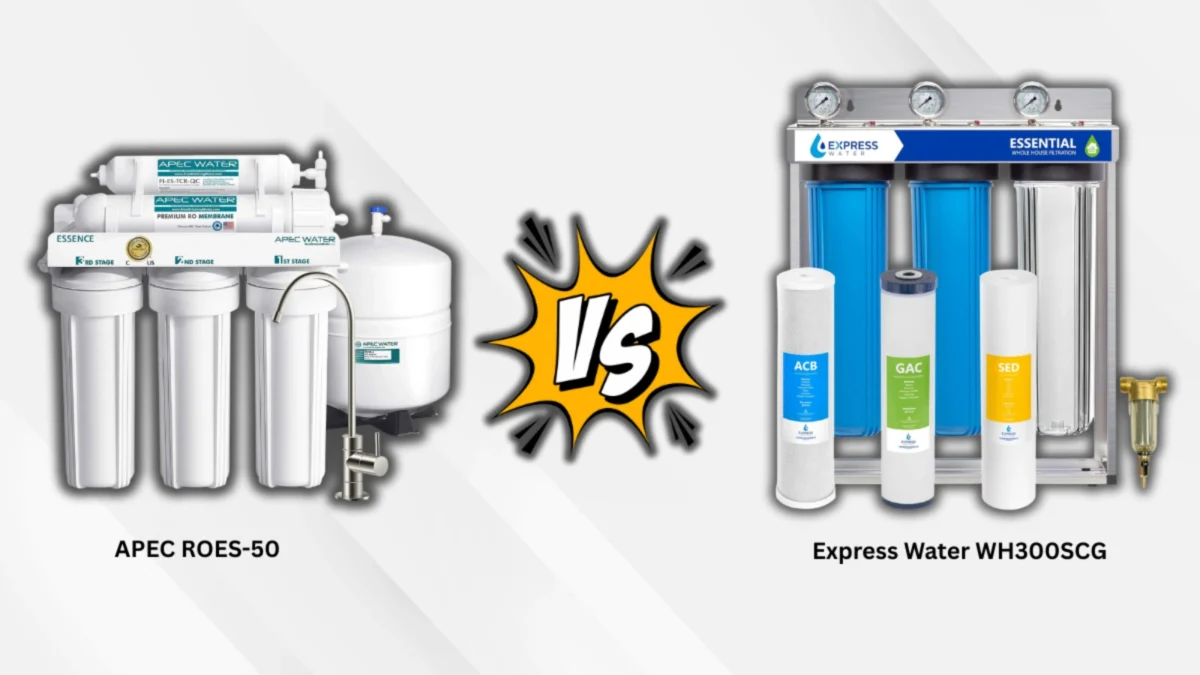
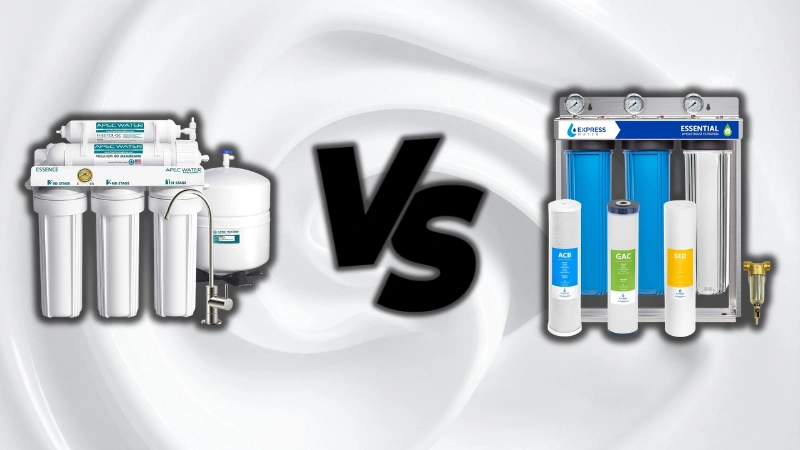
The Express Water WH300SCG (~$300) is your home’s shield — installed at the main water line, it strips chlorine, VOCs, sediment, and chemical load from every tap, shower, and appliance in the house. The APEC ROES-50 (~$400) is your biological architect — its 0.0001-micron RO membrane removes 99% of dissolved solids including lead, fluoride, and nitrates that whole-house filters cannot touch. Phase 1 protects your home’s infrastructure. Phase 2 protects your body. Running one without the other leaves a critical gap in your water system.
🔗 Together: Combined system cost ~$700. Over 5 years versus bottled water for a family of 4, you save approximately $1,600 — while protecting your appliances, your pipes, and your biology simultaneously. Installing the whole-house filter first also doubles the lifespan of your RO membrane by removing the heavy contaminant load before it reaches the RO stage.
💧 Can only start with one? If you have known lead, fluoride, or nitrate issues — start with the APEC RO. If you have hard water, scale buildup, or dry skin from showering — start with the Express Water whole-house system. Check your local water quality report at EPA.gov/ccr before deciding. See full decision framework →
Every sip of water, every 15-minute shower, and every load of laundry represents a point of interaction between your home’s environment and your body’s biology. This guide compares RO vs whole house water filtration using a system-level framework designed to protect both home infrastructure and human biology. For homeowners concerned with long-term health and systemic efficiency, viewing water quality as a singular, critical home system is essential.
Yet, navigating the choice between whole-house filtration and under-sink reverse osmosis (RO) systems often leads to confusion. Many settle for a partial solution, not realizing that each system serves a distinct purpose: one protects your home’s infrastructure, while the other protects your internal health.
This guide breaks down the decisive “Two-Phase Water Strategy” using the Express Water WH300SCG and the APEC ROES-50—the ultimate investment in comprehensive purity.
Phase 1: The “Shield” (Express Water WH300SCG Whole House)
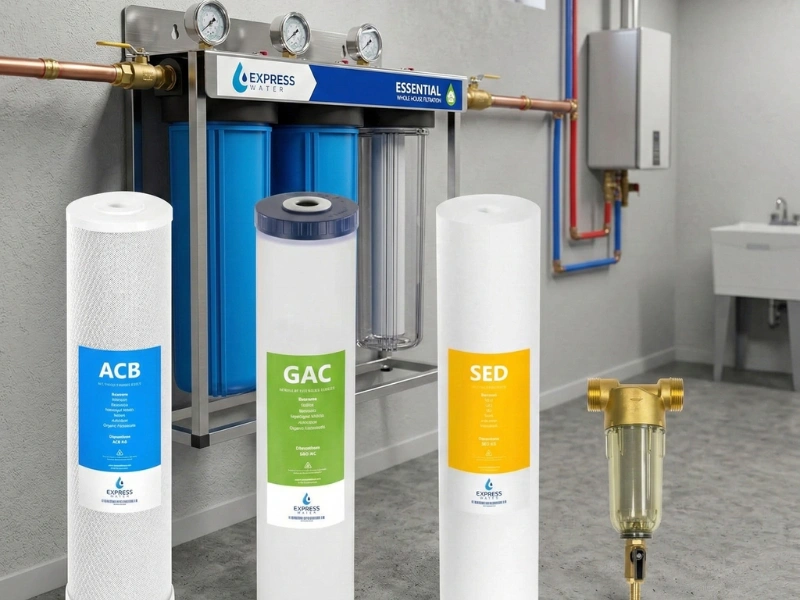
The whole-house system is your home’s first line of defense. Installed at the main water line, it acts as a “Point-of-Entry” (POE) shield.
The Science of Staged Micron Reduction
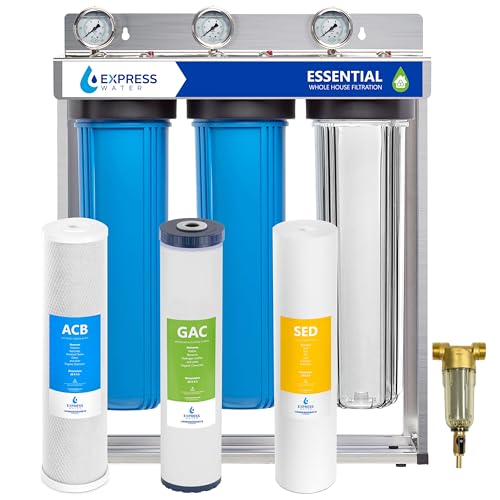
The Express Water WH300SCG utilizes a 3-stage process that focuses on “Physical and Chemical Loading.”
Stage 1 (Sediment): A 5-micron bodyguard that stops sand, rust, and silt. Without this, your appliances and subsequent filters would clog within weeks.
Stage 2 & 3 (Carbon Block): These stages target the “Chemical Burden.” By removing 99% of chlorine and VOCs, you are effectively stopping chemical absorption through your skin and lungs while showering.
Why “Clean-Smelling” Isn’t “Pure”
While the Express Water makes your water smell and taste like spring water, it is a Physical Barrier, not a molecular one. It leaves dissolved solids (TDS) like Lead, Fluoride, and Nitrates behind. For a complete look at these infrastructure-level protectors, see our list of the Best Whole House Water Filtration Systems.
Phase 2: The “Architect” (APEC ROES-50 Under-Sink)
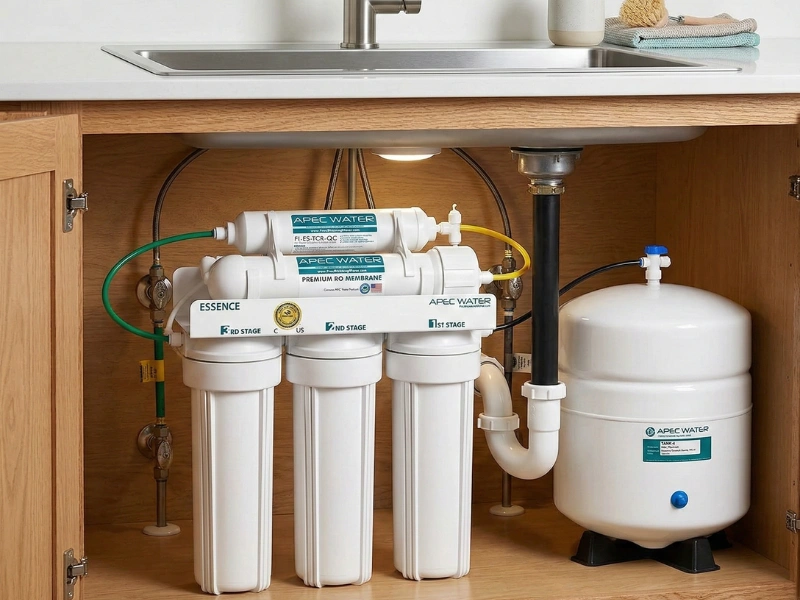
If the whole-house filter is the bodyguard, the APEC ROES-50 is the internal immune system. This 5-stage system is a “Point-of-Use” (POU) specialist.
The Molecular Barrier (0.0001 Microns)
The magic of the APEC system is the RO Membrane.
The Math: A human hair is 75 microns. A whole-house filter is 5 microns. The RO membrane is 0.0001 microns.
The Result: It rejects up to 99% of dissolved solids, specifically targeting Lead and Fluoride—two contaminants that standard whole-house filters simply cannot stop.
Biological Protection
This is the water you put into your cells. By using the APEC system for drinking and cooking, you are ensuring that your internal biological system isn’t tasked with “filtering” heavy metals through your liver and kidneys.
Express Water WH300SCG vs APEC ROES-50: Full System Specs
Specification
Express Water WH300SCG
APEC ROES-50
Combined System
Price (MSRP)
~$300
~$400
~$700 total
System Type
Whole House (POE)
Under-Sink RO (POU)
✅ Full coverage
Filtration Stages
3 stages
5 stages
8 stages combined
Filtration Precision
5 microns
0.0001 microns
5 → 0.0001 microns
Removes Chlorine / VOCs
✅ Yes — 99%
✅ Yes
✅ Both stages
Removes Lead / Heavy Metals
❌ No
✅ Yes — 99%
✅ Phase 2
Removes Fluoride
❌ No
✅ Yes — 95%+
✅ Phase 2
Removes Nitrates
❌ No
✅ Yes — 99%
✅ Phase 2
Removes Dissolved TDS
❌ No
✅ Yes — 99%
✅ Phase 2
Protects Pipes & Appliances
✅ Yes — whole home
Drinking water only
✅ Phase 1
Protects Skin & Lungs (Shower)
✅ Yes — all taps
Drinking water only
✅ Phase 1
Installation Complexity
High — professional recommended
Low — DIY weekend
Phase 1 first, then Phase 2
Filter Replacement Frequency
Every 3–6 months
Stages 1–3: 6–12 mo RO membrane: 2–3 yr
✅ Phase 1 extends RO membrane life 2x
5-Year Maintenance Cost
~$300–$500
~$400–$700
~$700–$1,200 combined
WQA Certified
NSF/ANSI 42 & 61
✅ WQA Gold Seal
✅ Both certified
Flow Rate
15 GPM whole house
50 GPD drinking water
High flow + high purity
TSH Role
Home Infrastructure Shield
Biological Purity Architect
Complete Water System
⚙️ Why the combined column matters: Installing the Express Water whole-house system upstream of the APEC RO removes sediment and chlorine before they reach the RO membrane — reducing the membrane’s contaminant load and extending its replacement interval from ~2 years to ~3–4 years. This cross-system benefit alone saves $100–$200 in membrane replacement costs over 5 years, further improving the combined system’s ROI.
RO vs Whole House Water Filtration: How the Two-Phase Strategy Works
The Two-Phase Synergy: Why You Need Both
In a Total System Health framework, we use a biological analogy to explain why these systems are better together:
Whole-House = The Integumentary System (Skin): It protects your home’s “skin” (pipes) and your actual skin. It stops chlorine from vaporizing into the air—a concept we also explore in our guide on How to Reduce Indoor Air Pollutants Naturally.
Reverse Osmosis = The Immune System: It meticulously filters what you ingest, acting as the final architect of your internal health.
The ROI of Integration: By installing the Express Water system first, you remove the “heavy lifting” (sediment and chlorine) before the water reaches your APEC RO. This doubles the life of your expensive RO membrane, significantly lowering your 5-year maintenance costs.
Installation Reality: DIY vs. Professional
As identified in our [Sustainable Tech Analysis], installation is where most homeowners encounter “System Failure.”
Express Water (High Complexity): This system is heavy (over 60 lbs when full of water). It requires cutting into your main copper or PEX line. Warning: Amazon reviews frequently mention leaks if Teflon tape isn’t applied generously or if O-rings aren’t seated with silicone grease. We recommend a professional plumber for this stage.
APEC RO (Low-Medium Complexity): This is a weekend DIY project. It requires a simple “tap” into your cold water line and a small hole in your sink for the dedicated faucet.
The 5-Year ROI: What a Two-Phase Water System Actually Costs vs. Everything Else
Most homeowners compare filtration systems against each other. The more useful comparison is filtration systems against the alternatives — bottled water, pitcher filters, and doing nothing. Here’s the full 5-year cost picture across household sizes.
Cost Category
Bottled Water
Pitcher Filter Only
RO Only (No Whole House)
Two-Phase System ✅
Initial Purchase
$0
~$40
~$400
~$700
5-Year Consumables
$3,000–$4,800
$600–$900
~$700
~$1,200
Appliance / Pipe Damage
−$500–$1,500
−$500–$1,500
−$500–$1,500
$0 (protected)
Lead / Fluoride Removal
✅ (brand dependent)
⚠️ Partial
✅ Yes — 99%
✅ Yes — 99%
Shower / Skin Protection
❌ None
❌ None
❌ None
✅ All taps + showers
Plastic Waste
~7,300 bottles/yr
Low
Zero
Zero
5-Year Total Cost
$3,500–$6,300
$1,140–$2,440
$1,100–$2,600
~$1,900
TSH Verdict
Most Expensive
Incomplete
Half the System
✅ Best Full Coverage
Bottled water cost based on family of 4 at $50–$80/month. Appliance damage estimate based on hard water scale damage to water heaters, dishwashers, and washing machines over 5 years. Filter replacement costs assume manufacturer-recommended intervals.
5-Year Savings by Household Size: Two-Phase System vs Bottled Water
Household Size
5-Yr Bottled Water Cost
Two-Phase System Total
Net 5-Year Savings
1–2 Person
~$1,800
~$1,900
Near breakeven — value is in protection
3–4 Person
~$3,000
~$1,900
Save ~$1,100
5–6 Person
~$4,800
~$1,900
Save ~$2,900
6+ Person
~$6,000+
~$1,900
Save $4,000+
The Hidden ROI Multiplier
Installing the Express Water whole-house system upstream of the APEC RO does more than protect your home — it strips sediment and chlorine before they reach the RO membrane, reducing its contaminant load. A standard RO membrane without pre-filtration typically lasts 1–2 years. With whole-house pre-filtration upstream, that same membrane can last 3–4 years. At ~$50–$80 per membrane replacement, that’s an additional $100–$160 saved per replacement cycle — a benefit that compounds across the system’s lifetime and is invisible in any single-system comparison.
⚡ Want to see exactly what your water filtration system costs to run? The Emporia Vue 3 vs Refoss EM16 guide shows how a home energy monitor tracks the real operating cost of every system running in your home — including your water infrastructure — down to the cent per day.
Which Water Filtration System Is Right for You?
The complete answer is always both — but your starting point depends on your water quality, home situation, and what problem you’re solving first. Here’s how to know exactly where to begin.
🔬 Phase 2 First
Start with the APEC ROES-50 RO System If…
⚠️ Your local water report shows lead, fluoride, or nitrate issues
These are dissolved contaminants that no whole-house sediment or carbon filter can remove — only an RO membrane at 0.0001 microns can stop them. If your EPA Consumer Confidence Report shows elevated lead, fluoride above 0.7 mg/L, or nitrates above 10 mg/L, the APEC RO is the urgent priority. What you drink and cook with goes directly into your biology — that gap closes first.
👶 You have young children or are pregnant
Lead exposure has no safe threshold for children under 6 — even low-level ingestion affects neurological development. Nitrates pose a direct risk to infants under 6 months (blue baby syndrome). For households with young children or pregnancy, biological water purity at the drinking and cooking tap is the non-negotiable first investment. The APEC RO eliminates both contaminants at 99% removal efficiency.
🏢 You rent and cannot modify the main water line
The Express Water whole-house system requires cutting into your main water line — that’s a structural modification most leases prohibit without landlord approval. The APEC RO installs under a single sink with no structural changes beyond a small hole for the dedicated faucet. For renters, it’s the only practical option for meaningful water filtration, and it handles the most critical biological protection anyway.
💰 Your budget is under $500 right now
At ~$400, the APEC RO delivers the highest biological protection per dollar of any filtration system in this category. It handles what matters most — what you put inside your body — at a price that leaves room to add the whole-house system in a future budget cycle. Start here, run it for 12–18 months while saving for Phase 1, and you’ll have meaningful protection in place the entire time.
🍳 Your primary concern is what you drink and cook with daily
The average person consumes 2–3 liters of water per day through drinking and cooking. That water goes directly into your bloodstream, kidneys, and cells. If your goal is optimizing internal biology — the water your body actually processes — the RO system is the more targeted and immediate intervention. The whole-house system protects your home’s infrastructure; the RO protects your body’s infrastructure. If you can only address one, protect the biology first.
🏡 You’re in an older home (pre-1986) with copper or lead pipes
Homes built before 1986 may have lead solder at pipe joints — meaning lead can leach directly into your water at the tap regardless of what your municipal supply looks like. The EPA banned lead solder in plumbing in 1986, but millions of homes predate that cutoff. If your home falls in this category, an RO system at your kitchen tap is the most direct way to intercept lead before it reaches your glass, regardless of what whole-house filtration you have or plan to add.
🛡️ Phase 1 First
Start with the Express Water WH300SCG If…
🚿 You have hard water, scale buildup, or dry skin after showering
Scale buildup (white residue around faucets and showerheads), blue-green staining in your tub, or chronic dry and itchy skin after showering are all signs of high chlorine load and hard mineral content in your supply water. These are whole-home problems that a single under-sink RO cannot solve — you are absorbing chlorine through your skin and inhaling chloroform vapor every time you shower. The whole-house carbon block stages address this at every point of contact simultaneously.
🏠 You want to protect appliances and extend their lifespan
Water heaters, dishwashers, washing machines, and ice makers are all degraded by sediment, rust, and hard minerals over time. Scale accumulation reduces water heater efficiency by up to 30% and can cut appliance lifespan in half. The whole-house system protects every water-connected appliance in your home simultaneously — treating this as home infrastructure investment rather than a health product changes the ROI calculation significantly. Appliance protection alone can justify the ~$300 purchase price within 2–3 years.
💨 You’re concerned about chlorine vapor in your home’s air
Hot showers vaporize chlorine and chloramines into the air of your bathroom — a space you typically occupy for 10–20 minutes with poor ventilation. This chloroform exposure through inhalation is often higher than what you’d absorb through drinking unfiltered water. If indoor air quality is a concern — particularly relevant if you’re also managing air filtration with a whole-home or portable HEPA system — removing chlorine at the water entry point closes the loop that an air purifier alone cannot fully address.
🐾 You have pets or use unfiltered water for plants and gardens
An under-sink RO only filters one tap. Every other water outlet in your home — the laundry room, outdoor hose, pet water bowl filled from the kitchen cold line, garden irrigation — still runs unfiltered supply water. If your household extends beyond the kitchen drinking tap, whole-house filtration delivers value across a much broader surface area. Pets and plants respond measurably to chlorine-free water, and the whole-house system covers all of it without installing individual filters at each point.
🔧 You’re planning to add an RO system next and want to maximize its lifespan
Installing whole-house filtration first is the strategically correct sequencing if you plan to eventually run both. By stripping sediment and chlorine before they reach your future RO membrane, Phase 1 acts as a pre-filter for Phase 2 — extending the RO membrane’s life from ~1–2 years to ~3–4 years. If you’re building this system in stages over 12–24 months, starting with the whole-house system makes every subsequent investment more efficient and more durable.
🌊 Your water visibly smells like chlorine or has a strong taste
If you can smell chlorine when running your tap, filling a bath, or washing dishes — your municipal supply has a high chlorine load that is affecting not just taste but every water interaction in your home. An RO system removes chlorine at one point of use. The whole-house carbon block stages remove it at every tap, shower, and appliance in the building. For high-chlorine supply areas, point-of-entry treatment is the more comprehensive and efficient solution.
✅ Complete Two-Phase System
Get Both Systems If…
🏡 You own your home and are thinking in 5–10 year infrastructure terms
Homeowners who think in infrastructure terms rather than product terms immediately recognize the logic: the whole-house system protects the building, the RO system protects the biology, and neither duplicates the other’s function. Over a 10-year horizon the combined ~$700 investment becomes one of the highest-ROI home upgrades available — cheaper than a single appliance repair and delivering compounding returns on health, appliance longevity, and water quality simultaneously.
💧 You want complete biological and infrastructure coverage with no gaps
Running either system alone leaves a gap. RO alone leaves your pipes, appliances, skin, and lungs exposed to chlorine, sediment, and chemical load at every non-kitchen tap. Whole-house alone leaves dissolved lead, fluoride, and nitrates in your drinking and cooking water. Only the two-phase combination closes both gaps simultaneously — which is why the Total System Health framework treats them as a single water infrastructure unit rather than two separate products.
👨👩👧👦 You have a family of 3 or more and currently buy bottled water
For a family of 4 spending $50–$80 per month on bottled water, the two-phase system pays for itself in under 18 months — and then delivers free, higher-quality water for the remaining years of the system’s life. The larger the household, the faster the financial breakeven. At 5+ people the 5-year savings versus bottled water exceed $2,900. The math compounds aggressively with household size, making this one of the clearest infrastructure investments available for larger families.
🧬 You follow a Total System Health approach to home environment optimization
Water is the single most consumed input your biology processes — more than food, more than air by volume per day. In a systems-level home health framework, water quality is not optional infrastructure: it is foundational. Every other optimization you make — air filtration, sleep environment, recovery protocols — is running on the baseline of what your cells are hydrated with. The two-phase water strategy is the water equivalent of what a whole-house filtration review makes clear: partial solutions leave systemic gaps that compound over decades.
Total System Health Verdict
The two-phase strategy is the answer. The only question is which phase you start with.
If your water report shows lead, fluoride, or nitrates — or if you rent — start with the APEC ROES-50. It protects your biology at the most critical point of contact. If you have hard water, scale buildup, dry skin, or are planning to add RO next — start with the Express Water WH300SCG. It protects your home’s infrastructure and sets up Phase 2 to perform better and last longer. If you can do both now — do both. At ~$700 combined, it is the most cost-effective full-spectrum water investment available at any price point.
The most common questions about RO and whole house filtration answered from a systems perspective.
What is the difference between RO and whole house water filtration?
Whole house filtration (Point-of-Entry) installs at your main water line and treats every tap, shower, and appliance in the home. It targets physical and chemical contaminants like sediment, chlorine, and VOCs — protecting your home’s infrastructure and reducing dermal and respiratory chlorine exposure. Reverse osmosis (Point-of-Use) installs under a single sink and pushes water through a 0.0001-micron membrane that removes dissolved solids including lead, fluoride, nitrates, and heavy metals that whole-house carbon filters cannot stop. They solve fundamentally different problems — whole house protects your home’s biology, RO protects your internal biology.
Does a whole house filter remove lead and fluoride?
No — standard whole house sediment and carbon block filters like the Express Water WH300SCG do not remove lead, fluoride, or nitrates. These are dissolved ionic contaminants that pass straight through physical and carbon filtration stages. Only a reverse osmosis membrane operating at 0.0001 microns can reject them at 95–99% removal rates. This is the single most important reason the two-phase strategy exists — whole house filtration alone leaves the most biologically dangerous contaminants in your drinking water.
How long does an RO membrane last and what extends its life?
A standard RO membrane in a home without pre-filtration typically lasts 1–2 years before performance degrades. With a whole-house filtration system installed upstream, the same membrane can last 3–4 years — because the sediment and chlorine that normally foul the membrane have already been removed before the water reaches the RO stage. The pre-filter stages on the APEC unit (stages 1–3) handle additional sediment and carbon filtration and should be replaced every 6–12 months. The combination of upstream whole-house filtration and regular pre-filter replacement is the most cost-effective way to maximize membrane lifespan.
Can I install a whole house water filter myself or do I need a plumber?
The Express Water WH300SCG whole house system requires cutting into your main water supply line — a task that involves shutting off water to the entire house, making copper or PEX pipe connections, and managing a unit that weighs over 60 lbs when full. Amazon reviews consistently flag leaks when Teflon tape is applied insufficiently or O-rings are not seated with silicone grease. Professional installation is strongly recommended for Phase 1. The APEC ROES-50 under-sink RO is the opposite — it is a genuine DIY weekend project requiring only a tap into the cold water supply line and a small hole in your sink for the dedicated faucet. Most homeowners complete it in 2–3 hours with basic tools.
How do I find out what contaminants are in my local water supply?
The EPA requires every municipal water supplier to publish an annual Consumer Confidence Report (CCR) disclosing detected contaminant levels. You can find yours at EPA.gov/ccr by entering your zip code or water utility name. Look specifically for lead (action level: 15 ppb), nitrates (limit: 10 mg/L), and fluoride (recommended limit: 0.7 mg/L). If your home was built before 1986, also consider a point-of-use lead test kit — older home plumbing can leach lead even when the municipal supply tests clean at the treatment plant.
Is RO water safe to drink daily — does it remove beneficial minerals?
RO water is safe for daily consumption and is the standard of care in clinical and laboratory settings. The concern about mineral removal is real but contextually minor — RO does remove calcium and magnesium along with contaminants, producing low-TDS water. However, the human body derives less than 5% of its daily mineral intake from water — the overwhelming majority comes from food. If mineral content is a concern, a remineralization post-filter stage (available as an add-on for the APEC system) adds back trace calcium and magnesium and raises pH slightly. For most households the standard 5-stage APEC is sufficient without remineralization.
How much water does an RO system waste and is it a concern?
Traditional RO systems like the APEC ROES-50 use a 3:1 to 4:1 drain-to-product ratio — meaning 3–4 gallons of water are sent to drain for every 1 gallon of purified water produced. For a family of 4 using approximately 3–4 gallons of drinking and cooking water per day, this means 9–16 additional gallons of drain water daily — a modest increase on a typical household water bill of roughly $3–$6 per month. In drought-affected regions or homes on well water this is worth factoring into your decision. Higher-efficiency RO systems with permeate pumps or tankless designs reduce this ratio to 1:1, but at higher upfront cost. For most municipal water customers the waste ratio is an acceptable trade-off for the biological protection provided.
TSH Interactive Tool
Water Filtration Cost Calculator
Enter your situation — get your personalized system recommendation and 5-year cost comparison.
Removes: chlorine, VOCs, sediment · Pro install recommended
⚠️ Older Home Alert: Homes built before 1986 may have lead solder at pipe joints. Even if your municipal water tests clean, lead can leach from your home’s own plumbing. An RO system at your kitchen tap is the most direct way to intercept this — regardless of your other filtration choices. Consider a point-of-use lead test kit before relying solely on municipal water reports.
🏢 Renter Note: The Express Water whole-house system requires cutting into your main water line — most leases prohibit this without landlord approval. The APEC ROES-50 installs under a single sink with no structural modifications and is the practical choice for renters. It handles the most critical biological protection regardless of what your building’s plumbing looks like.
TSH Recommends
Disclaimer: This article is for informational purposes only and does not constitute medical or health advice. Water quality concerns involving lead exposure, particularly for pregnant women, infants, or young children, should be addressed in consultation with a qualified healthcare provider or licensed plumber. Always verify local water contaminant levels using your municipality’s Consumer Confidence Report at EPA.gov/ccr before making filtration decisions.
Conclusion: Clean Water as Home Infrastructure
The choice between RO and Whole House filtration is a false binary. A holistic view of home health recognizes that water is an environmental input that must be managed at two levels: Infrastructure and Ingestion.
The Express Water WH300SCG safeguards your home’s physical integrity, while the APEC ROES-50 guarantees your biological purity. Together, they represent the pinnacle of responsible home stewardship.