Total System Health is reader‑supported. When you purchase through links on our site, we may earn an affiliate commission at no additional cost to you. For more details, please see our Privacy Policy.
Total System Health Note: Humidity control is the “Moisture Guard” of your home’s ecosystem. To automate this system, we recommend pairing these units with an ecobee Smart Thermostat Premium using its dedicated 24V accessory control.
Quick Verdict — Skip to What Matters
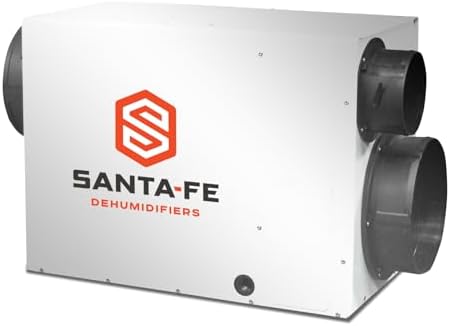
Choose the Santa Fe Ultra120 if your priority is total air quality: MERV-13 hospital-grade filtration, fresh-air ventilation for CO₂ dilution, and the highest efficiency rating in the category at 2.95 L/kWh. At ~$1,870–$2,100, it pays for itself vs. running three portables in under 3 years. FSA/HSA eligible — saves up to $735 at the 35% tax bracket.
Choose the AprilAire E100 Pro Bundle if your priority is rugged reliability in harsh crawl spaces: corrosion-resistant aluminum coils that outlast copper in damp or coastal environments, 4.8-star contractor trust rating, and a complete Pro Bundle with all accessories included. At ~$1,870, it pays for itself vs. portables in under 3 years. FSA/HSA eligible — saves up to $700 at the 35% bracket.
The real decision: Air quality specialist with MERV-13 + ventilation (Santa Fe) vs. corrosion-proof moisture workhorse built for extreme environments (AprilAire). Both destroy the economics of portable dehumidifiers within 36 months.
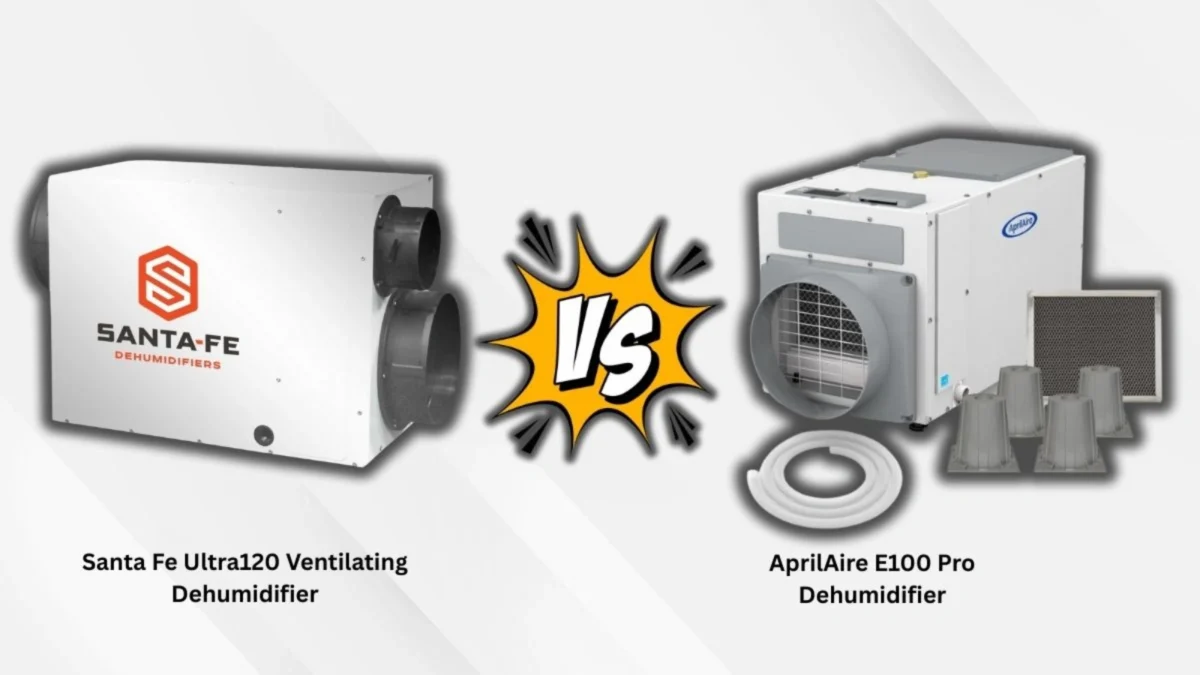
Santa Fe Ultra120 vs AprilAire E100 is one of the most common comparisons homeowners make when choosing a whole-home dehumidifier for basements, crawl spaces, and sealed homes.
The Invisible Rot Problem
A properly designed whole home dehumidifier is not a comfort upgrade—it is critical infrastructure that protects air quality, structural assets, and long-term health. When we think of water damage, we envision catastrophic floods or localized pipe leaks. But the true enemy of home health is far more insidious and persistent: elevated Relative Humidity (RH). In the world of environmental engineering, once you cross the threshold of 60% RH, you have effectively granted “Biological Permission.”
At this precise humidity level, dormant mold spores—which exist in every home—find the moisture they need to germinate and colonize your structural materials. Simultaneously, dust mite populations, a primary source of chronic indoor allergens, thrive and multiply at an exponential rate. This isn’t merely a matter of “sticky” or “clammy” air; it is the creation of a state-wide Biological Load that significantly elevates your home’s Total Body Burden. This term refers to the cumulative stress that allergens, microbes, and chemical irritants place on your immune and respiratory systems every hour you are inside.
The damage of uncontrolled moisture extends beyond biology into the very physics of your home. High humidity acts as a silent catalyst for the physical decay of your property assets. It accelerates the timeline of wood rot in floor joists, compromises the R-value of your insulation, and drastically increases VOC off-gassing from damp building materials like drywall and pressed-wood furniture. The problem is never localized; it is a system-wide condition that permeates your walls, your furnishings, and the very air your family breathes.
Whole Home Dehumidifier vs Portable Units: Why Infrastructure Wins
The common, reactive response to a damp basement or crawl space is to purchase a portable dehumidifier from a big-box retailer. This is a tactical error—a reactive approach to a strategic, whole-home problem.
In a Total System Health framework, we distinguish between Appliances and Infrastructure. Portable units are appliances: they are designed for local, temporary symptom relief. A whole-home dehumidifier, such as the Santa Fe Ultra120 or the AprilAire E100, is infrastructure: it is designed for permanent, system-wide prevention.
Consider the engineering mismatch of the portable model:
- Pressure Imbalance: Portable units operate in a single room, creating a fleeting “dry zone” while moisture continues to migrate through the rest of the house due to vapor pressure.
- The Maintenance Trap: Portables rely on human intervention (emptying tanks) or weak gravity drains that frequently clog. Infrastructure systems are plumbed directly into your home’s waste lines.
- Filtration Failure: The filters on portables are rudimentary mesh screens. This allows dust to coat the internal coils, which drastically reduces efficiency and leads to the “disposable cycle”—where the unit burns out and is sent to a landfill every 24 months.
| Specification | Santa Fe Ultra120 | AprilAire E100 Pro Bundle |
|---|---|---|
| Price (Amazon) | ~$1,870–$2,100 | ~$1,870 (Pro Bundle) |
| Capacity (AHAM) | 120 pints/day | 100 pints/day |
| Coverage Area | Up to 2,600 sq ft | Up to 5,500 sq ft |
| Energy Factor | 2.95 L/kWh ⭐ Most Efficient | 2.35 L/kWh |
| Energy Star Rating | ⭐ Most Efficient | ✅ Energy Star Certified |
| Filtration Level | MERV-13 (Hospital Grade) | MERV-8 (Washable) |
| Fresh-Air Ventilation Port | ✅ Yes (optional ducting) | ❌ No |
| Coil Material | Copper | Aluminum (Corrosion-Resistant) |
| Control Logic | 24V (ecobee/Nest compatible) | 24V (ecobee/Nest compatible) |
| Drain Options | Direct drain (no tank) | Direct drain (Pro Bundle includes kit) |
| Min Operating Temp | 40°F (crawl space ready) | 50°F |
| Noise Level | ~56 dB | ~56 dB |
| Unit Dimensions | 26″ × 20″ × 13.5″ | 28.5″ × 14.75″ × 15.25″ |
| Unit Weight | ~105 lbs | ~91 lbs |
| Warranty | 6-Year Limited | 5-Year (included in bundle) |
| Expected Lifespan | 12–15 years | 10–15 years |
| FSA/HSA Eligible | ✅ Yes | ✅ Yes |
| Best For | Total air quality + efficiency + tight homes needing CO₂ dilution | Crawl spaces, coastal/harsh environments, contractor installs, simplicity |
The core failure of the “just buy three portables” argument is a misunderstanding of scope. Humidity is a load calculation on the entire enclosed space of your home. Infrastructure is engineered to manage this total load, 24/7, without human intervention, protecting both your air and your structural assets for decades.
Meet the Systems: The Elite Tier of Humidity Control
In the realm of true whole-home moisture management, two names consistently define the professional standard: the Santa Fe Ultra120 and the AprilAire E100. These are not simply “upgraded” appliances; they represent the elite tier of environmental control infrastructure.
Both are engineered from the ground up for Continuous Duty Cycles, designed to be integrated into your home’s central HVAC or standalone ducting. Once installed and calibrated via your smart thermostat, these systems operate silently and reliably for over a decade. They represent a fundamental shift from reactive, plastic-box dehumidifiers to a permanent, systemic solution. While they share this core philosophy, their engineering priorities diverge, carving distinct paths to the same goal: a perfectly dry, structurally sound, and biologically quieter home.
Product Deep-Dive #1: Santa Fe Ultra120 — The Specialist
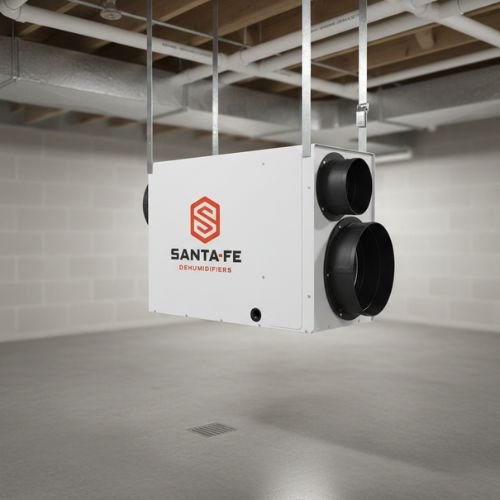
Check Today’s Price for the Santa Fe Ultra120 on Amazon
The Santa Fe Ultra120 is engineered not just to remove water, but to systematically dismantle the conditions that compromise indoor environmental purity. Its core capacity is a robust 120 pints per day (as per AHAM testing standards), enabling it to handle the latent load of even a large, multi-story home or a poorly sealed basement. However, its true differentiation lies in its multi-system approach to Biological Load reduction.
Hospital-Grade Filtration (MERV-13)
The cornerstone of the Santa Fe strategy is its integrated MERV-13 media filtration. While standard dehumidifiers might include a basic mesh screen, the Ultra120’s filter is a hospital-grade barrier capable of capturing over 90% of particles as small as 1-3 microns.
This size range is critical—it’s the exact size of most mold spores, pollen, and a significant portion of bacteria. By removing these particulates from the air before they pass through the cold, wet evaporator coil, the system prevents the coil from becoming an accidental incubator. This creates a virtuous cycle: dry, filtered air is circulated, reducing the overall Microbial Pressure in your home’s ecosystem.
Ventilation as Health Infrastructure
Furthermore, the Ultra120 incorporates an optional fresh-air ventilation port. This allows it to introduce controlled, filtered outdoor air, actively diluting indoor pollutants like CO₂ and VOCs, and replenishing oxygen. This transforms the unit from a mere dehumidifier into a comprehensive air chemistry manager.
The system is controlled via sophisticated 24V control logic, allowing seamless integration with a “Home Brain” like the ecobee Smart Thermostat Premium for fully automated, demand-based operation. In essence, the Santa Fe Ultra120 is the specialist you choose when your goal is total environmental purity, not just dryness.
Product Deep-Dive #2: AprilAire E100 — The Workhorse
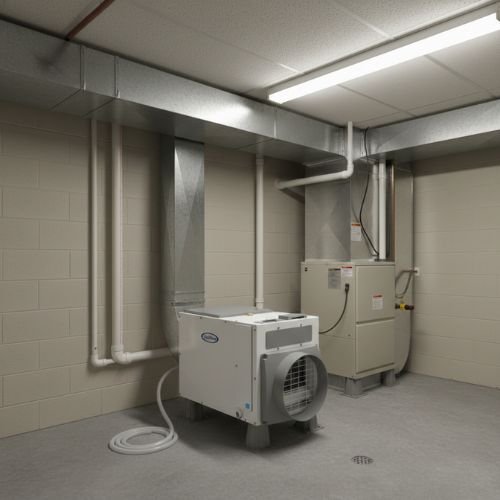
Check Today’s Price for the AprilAire E100 Pro Bundle on Amazon
Where the Santa Fe innovates with integrated filtration and ventilation, the AprilAire E100 excels through rugged, uncompromising reliability. It is the undisputed moisture workhorse, built with a singular, durable focus on extracting water with maximum longevity.
Corrosion-Resistant Aluminum Coils
In harsh, corrosive environments like damp crawl spaces or salty coastal air, traditional copper coils are vulnerable to formicary corrosion—a leading cause of premature system failure and refrigerant leaks. AprilAire’s Corrosion-Resistant Aluminum Coils are intrinsically resistant to this decay, ensuring the heart of the dehumidifier remains functional for its entire service life.
This focus on durability over “features” is reflected in its simpler, robust airflow path and a washable MERV-8 filter, which protects the internal components without the need for high-maintenance advanced media.
Social Proof & Contractor Trust
This no-nonsense, reliability-first philosophy has earned the AprilAire E100 immense trust within the professional contractor community and exceptional social proof, maintaining a consistent 4.8-star rating on Amazon. Professionals view it as a predictable, serviceable tool that eliminates the “callback” issues common with cheaper units.
Its installation is streamlined, often coming in a “Pro Bundle” with all necessary components, making it the preferred choice for targeting problem areas like crawl spaces or standalone basement applications where simplicity and resilience are paramount. The AprilAire E100 doesn’t seek to change your home’s air chemistry; it dedicates all its engineering might to doing one indispensable job perfectly for up to 15 years: keeping the structure demonstrably, reliably dry.

- AprilAire Dehumidifier Bundle: More for same price! Includes all the dehumidifier accessories you will need. Our Aprilai…
- Set & Forget: There is no messy water tray to empty and set up is simple. Set the target humidity and smart sensing tech…
- Energy Efficient: This ENERGY STAR Most Efficient certified dehumidifier removes up to 100 pints (12.5 gallons) of moist…
The Efficiency Gap Explained (Why 25% Matters)
The critical metric separating premium infrastructure from mere appliances is the Energy Factor, measured in Liters per kilowatt-hour (L/kWh). This isn’t a marketing buzzword; it is the fundamental engineering measurement of how effectively a machine converts electricity into moisture removal.
The Santa Fe Ultra120 leads the industry with a rating of 2.95 L/kWh, earning it the prestigious Energy Star “Most Efficient” certification. In comparison, the AprilAire E100 achieves a respectable 2.35 L/kWh. While both are far superior to retail portables, this constitutes a significant ~25% efficiency gap.
The Math of Compounding Savings
In practical terms, for every kilowatt-hour of electricity consumed, the Santa Fe removes 2.95 liters of water, while the AprilAire removes 2.35 liters. To remove the same volume of moisture from your home, the AprilAire system must draw more power for a longer duration.
While the cost difference per day may seem negligible, a whole-home dehumidifier is designed to operate for thousands of hours—often 1,500 to 3,000 hours annually in humid climates. Over a 10-year lifespan, this 25% efficiency gap compounds like interest. For homeowners in high-humidity regions or those with expensive local electricity rates, the operational savings of the Santa Fe can eventually offset its initial price premium. It is a classic case of paying for superior engineering upfront to reduce the “Energy Tax” on your home system long-term.
Ventilation vs. Dehumidification Only (The Oxygen Loop)
Modern, energy-efficient homes are often “too tight.” While this saves on heating and cooling, it creates a vessel for stale, biologically active air. This is where the Santa Fe Ultra120’s integrated Fresh-Air Ventilation Port provides a decisive strategic advantage for Total System Health.
Most modern homes effectively trap exhaled CO₂, VOCs from furnishings, and other metabolic pollutants. The AprilAire E100 is a high-performance dehumidification-only workhorse; it recirculates and dries the existing indoor air perfectly, but it does not change the air’s chemical composition.
Engineering Your Air Chemistry
The Santa Fe Ultra120, however, can be configured to introduce a measured amount of outdoor air into the home. This air is first pulled through the unit’s MERV-13 filter—stripping it of pollen and mold spores—before being dehumidified and distributed.
This process achieves CO₂ Dilution and Oxygen Replenishment, actively lowering the Total Body Burden of inhaled pollutants. By combining moisture control with mechanical ventilation, you are attacking two systems at once: you are removing the biological permission for mold growth while simultaneously flushing out chemical irritants. This aligns perfectly with our foundational strategies on How to Reduce Indoor Air Pollutants Naturally.
Installation & Control Reality (The “Lungs” of Your Home)
The prospect of installing a 100-pound piece of machinery into your HVAC ductwork can be daunting. However, both systems are engineered for professional simplicity using standard 24V Control Logic. This is the same low-voltage “language” spoken by your furnace and air conditioner, allowing these units to act as the automated “Lungs” of your house.
The “Brain-Hand” Loop
To achieve a fully optimized home environment, these systems should be “slaved” to a smart “Brain.” The ideal executive controller for this infrastructure is a device like the ecobee Smart Thermostat Premium.
The ecobee monitors whole-home humidity levels in real-time and automatically commands the dehumidifier to engage the moment levels rise above your setpoint (typically 50% RH). This eliminates manual intervention and ensures your home remains a sanctuary of Environmental Purity 24 hours a day.
- AprilAire Tip: The E100 often wins on installation simplicity in standalone crawl space applications due to its straightforward “Pro Bundle” accessories.
- Santa Fe Tip: The Ultra120 requires more advanced planning for the fresh-air ducting but enables a deeper level of integration with your home’s overall air quality strategy.
Long-Term ROI: Infrastructure vs. Disposable Math
To understand the true value of humidity control, you must analyze the Total Cost of Ownership (TCO) over a decade. The common strategy of using multiple portable units is actually a cycle of recurring, disposable expense.
A typical household might buy three high‑end portable units (around $300 each) to cover a basement or crawl space. Because these units are built with thin‑gauge coils and lack professional‑grade cooling systems, they typically fail every 2.5 to 3 years. Over a decade, this cycle results in over $3,600 in hardware costs alone, not including the inflated energy bills caused by their poor efficiency ratings (often below 1.5 L/kWh).
Contrast this with a single $2,000–$2,500 whole‑home system. These units are engineered for a 10–15 year lifespan and carry a 25% higher efficiency rating. The financial math is unequivocal: Infrastructure is cheaper precisely because it lasts. You are not buying a “dehumidifier”; you are capitalizing an asset that appreciates in value through energy savings, protected property, and mitigated health risks. The higher upfront cost is quickly dwarfed by the recurrent waste of the disposable appliance model.
FSA/HSA Eligibility: How to Buy Your Dehumidifier With Pre-Tax Dollars
Both the Santa Fe Ultra120 and AprilAire E100 qualify for FSA (Flexible Spending Account) and HSA (Health Savings Account) reimbursement when purchased to treat or prevent a medically documented condition — including chronic allergies, asthma, respiratory illness, or physician-diagnosed mold sensitivity. At a ~$1,870 price point, this is a $400–$735 savings most buyers leave on the table.
Your After-Tax Cost by Bracket
| Tax Bracket | Santa Fe Ultra120 ~$2,100 list | FSA/HSA Savings | AprilAire E100 ~$1,870 list | FSA/HSA Savings |
|---|---|---|---|---|
| 22% Bracket | $1,638 effective | Save $462 | $1,459 effective | Save $411 |
| 30% Bracket | $1,470 effective | Save $630 | $1,309 effective | Save $561 |
| 35% Bracket | $1,365 effective | Save $735 | $1,216 effective | Save $654 |
2026 Contribution Limits
HSA individual limit: $4,300 | HSA family limit: $8,550 | FSA limit: $3,300. Both units fall well within a single year’s FSA or HSA contribution, meaning you can fund the entire purchase with pre-tax dollars in one cycle.
How to Get Approved — 3-Step Process
Step 1 — Letter of Medical Necessity (LMN): Request a letter from your physician documenting that a whole-home dehumidifier is medically necessary for a diagnosed condition such as chronic allergies, asthma, mold sensitivity, or respiratory illness. This is the critical document that converts a home appliance into a qualified medical expense.
Step 2 — Purchase and save your receipt: Buy through Amazon using your FSA/HSA card directly, or purchase normally and submit for reimbursement. Keep the Amazon order confirmation as your receipt.
Step 3 — Submit to your FSA/HSA administrator: Upload your LMN and receipt to your plan portal. Most administrators process reimbursements within 5–10 business days. If your FSA/HSA card is declined at checkout, reimbursement submission with the LMN is the reliable fallback path.
💡 Total System Health Tip: After installation, pair your dehumidifier with an Emporia Vue 3 or Refoss EM16 energy monitor to track your dehumidifier’s exact daily kWh draw in real time. This gives you a precise, documented energy cost per month — useful both for validating your ROI math and for supporting your FSA/HSA reimbursement documentation with real usage data.
Whole Home Dehumidifier Sizing Calculator
Answer 4 questions to get your mold risk score, the right unit for your home, and your exact payback period vs running portable dehumidifiers.
Step 1 of 3 — Your Home
The System Bodyguard: Protecting HVAC and Assets
A whole-home dehumidifier acts as the indispensable bodyguard for your home’s most expensive infrastructure. By maintaining optimal humidity, it provides a dual-layer of protection:
Mechanical Protection: The HVAC Shield
Dry air prevents microbial growth on your central AC’s evaporator coils—the leading cause of “Dirty Sock Syndrome” and clogged drains. More critically, it drastically reduces the risk of formicary corrosion. This is the microscopic pitting that causes catastrophic refrigerant leaks in copper coils. By preventing this chemical reaction, you are effectively protecting yourself from a $5,000+ full HVAC system replacement.
Structural Protection: Preserving the Envelope
By keeping your wood framing, subflooring, and insulation below the moisture threshold for decay, you are preserving your home’s Structural Integrity. Moisture management also eliminates the massive VOC off-gassing that occurs when damp building materials interact with heat. This transition—from a comfort tool to a core component of asset preservation—is why humidity control is a non-negotiable part of our Home Optimization framework.
Whole Home Dehumidifier Decision Matrix: Santa Fe Ultra120 vs AprilAire E100
Your choice between these two systems comes down to one question: are you engineering for total air quality or maximum durability in a harsh environment? Both destroy the economics of portable dehumidifiers. The difference is in what each unit does beyond moisture removal.
Choose the Santa Fe Ultra120 if:
🫁 Total air quality is your primary goal. The MERV-13 filtration captures mold spores, pollen, and bacteria at the 1–3 micron range — the same tier used in hospital environments. If someone in your household has chronic allergies, asthma, or physician-documented mold sensitivity, this filtration level is non-negotiable. The AprilAire’s MERV-8 filter protects the unit’s internals; the Santa Fe’s MERV-13 actively cleans your air.
🏠 You live in a modern, energy-efficient “tight” home. Homes built after 2000 with spray foam insulation or high-efficiency windows trap CO₂, VOCs, and metabolic pollutants because there is no natural air exchange. The Santa Fe’s fresh-air ventilation port is the only system in this comparison that can actively dilute indoor chemical load while simultaneously dehumidifying. If your home ever feels “stuffy” despite good HVAC, this is the engineering fix.
⚡ Maximum long-term efficiency matters to you. The 2.95 L/kWh energy factor vs the AprilAire’s 2.35 L/kWh represents a ~25% efficiency gap that compounds over 1,500–3,000 annual operating hours in humid climates. Over a 10-year lifespan in a high-humidity region, this difference offsets a meaningful portion of the Santa Fe’s price premium. It is the only unit in the category with Energy Star “Most Efficient” certification.
🌡️ Your crawl space or basement runs below 50°F in winter. The Santa Fe Ultra120 operates down to 40°F — a full 10°F lower than the AprilAire E100’s 50°F minimum. In unheated crawl spaces in northern climates, this operating range difference determines whether your dehumidifier actually runs during shoulder seasons or sits idle while moisture accumulates.
🔗 You want full smart home integration with ventilation. The Santa Fe pairs with ecobee or Nest via 24V control logic for automated demand-based operation, and its ventilation port can be ducted into your HVAC return — making it a true component of your home’s air management system rather than a standalone appliance.
💰 You want the highest FSA/HSA savings. At ~$2,100, the Santa Fe generates up to $735 in pre-tax savings at the 35% bracket — the highest dollar savings of the two units. With an LMN for allergies or respiratory conditions, this brings the effective cost to ~$1,365.
Choose the AprilAire E100 Pro Bundle if:
🌊 Your environment is coastal, damp, or chemically aggressive. Formicary corrosion — the microscopic pitting that destroys copper coils from formic acid exposure in damp environments — is the leading cause of premature dehumidifier failure. The AprilAire’s aluminum coils are intrinsically immune to this failure mode. If you are within 50 miles of a coastline, in a heavily wooded humid region, or have a history of HVAC coil failures, aluminum is the correct engineering choice regardless of other factors.
🏗️ You need the largest coverage area. The AprilAire E100 is rated for up to 5,500 sq ft vs the Santa Fe’s 2,600 sq ft. For larger homes, open floor plans, or installations serving multiple connected zones from a single unit, the AprilAire’s superior raw capacity makes it the technically correct choice — not a compromise.
🔧 You are hiring a contractor for installation. The AprilAire E100 has earned its 4.8-star rating largely through contractor trust. HVAC professionals recommend it because its Pro Bundle includes every accessory needed for a complete install, its airflow path is straightforward, and its service history is predictable. If you are not doing a DIY install, your contractor has almost certainly installed dozens of these and knows the failure points — that institutional knowledge has real value.
🎯 Your goal is targeted crawl space or basement protection — nothing more. If moisture control is the only objective and you do not need MERV-13 air filtration or fresh-air ventilation, the AprilAire’s simplified airflow path means fewer components, fewer potential failure points, and lower maintenance complexity over its 10–15 year lifespan. Simplicity engineered for a single purpose is a legitimate advantage.
📦 You want everything included out of the box. The Pro Bundle ships with all ducting accessories, drain kit, and mounting hardware. The Santa Fe Ultra120 often requires separate purchases for fresh-air ducting components if you want the full ventilation capability. For buyers who want a complete system at a single price with no follow-up orders, the AprilAire bundle wins on simplicity.
💰 You want strong FSA/HSA savings at a lower price point. At ~$1,870, the AprilAire generates up to $654 in pre-tax savings at the 35% bracket — bringing the effective cost to ~$1,216. For buyers who qualify and submit an LMN, this is one of the lowest effective costs for professional-grade whole-home dehumidification available.
Total System Health Verdict
For most homeowners optimizing a modern home for long-term health and energy efficiency, the Santa Fe Ultra120 is the correct infrastructure choice — not because it is more expensive, but because MERV-13 filtration and fresh-air ventilation address biological load that dehumidification alone cannot touch. When your goal is Total System Health and not just structural dryness, the Santa Fe is the only unit in this comparison that treats your air as a complete biological environment.
The AprilAire E100 is the correct choice for coastal environments, large square footage, contractor-led installations, and any scenario where corrosion-resistant aluminum coils are the engineering priority. It is not a compromise — it is the right tool for a specific, well-defined job. If your situation matches even one of its buyer profiles above, choose it without hesitation.
Frequently Asked Questions About Whole Home Dehumidifiers
❓ What is a whole home dehumidifier, and how is it different from a portable unit?
A whole home dehumidifier is a permanently installed system designed to control humidity across the entire house using ducted airflow and automated controls. Unlike portable units that only dry a single room and require frequent emptying or replacement, a whole home dehumidifier operates continuously, drains automatically, and protects the home’s structure, HVAC system, and indoor air quality long-term.
❓ Is a whole home dehumidifier worth the cost compared to buying multiple portable units?
Yes. While the upfront cost of a whole home dehumidifier is higher, the total cost of ownership is significantly lower over time. Portable units typically fail every 2–3 years, consume more electricity per pint of water removed, and provide incomplete moisture control. A whole home system is engineered to last 10–15 years, uses less energy per liter removed, and prevents costly damage from mold, wood rot, and HVAC corrosion.
❓ What humidity level should a whole home dehumidifier maintain?
Most experts recommend maintaining indoor relative humidity between 45% and 50%. Levels above 60% create ideal conditions for mold growth, dust mites, and VOC off-gassing from building materials. A properly configured whole home dehumidifier automatically maintains this safe range year-round.
❓ Can a whole home dehumidifier improve indoor air quality?
Absolutely. By removing excess moisture, a whole home dehumidifier reduces mold spores, dust mites, and microbial growth. Systems like the Santa Fe Ultra120 go a step further by using MERV-13 filtration and optional fresh-air ventilation, which helps dilute indoor CO₂ and VOCs while introducing filtered outdoor air.
❓ What is the difference between the Santa Fe Ultra120 and AprilAire E100?
The Santa Fe Ultra120 prioritizes maximum efficiency, advanced MERV-13 filtration, and optional fresh-air ventilation for homes focused on total air quality optimization. The AprilAire E100 focuses on rugged simplicity, corrosion-resistant aluminum coils, and reliable moisture removal, making it ideal for crawl spaces and basements where durability and ease of installation are the top priorities.
❓ Does a whole home dehumidifier work with a smart thermostat like ecobee?
Yes. Both the Santa Fe Ultra120 and AprilAire E100 use standard 24-volt control logic and can be integrated with smart thermostats such as the ecobee Smart Thermostat Premium. This allows automated humidity control based on real-time conditions without manual intervention.
❓ Where is a whole home dehumidifier typically installed?
Whole home dehumidifiers are commonly installed in basements, sealed crawl spaces, mechanical rooms, or connected directly to HVAC ductwork. The installation location depends on whether the goal is full-home humidity control, targeted crawl space protection, or integration with ventilation and filtration systems.
Engineering the System Loop
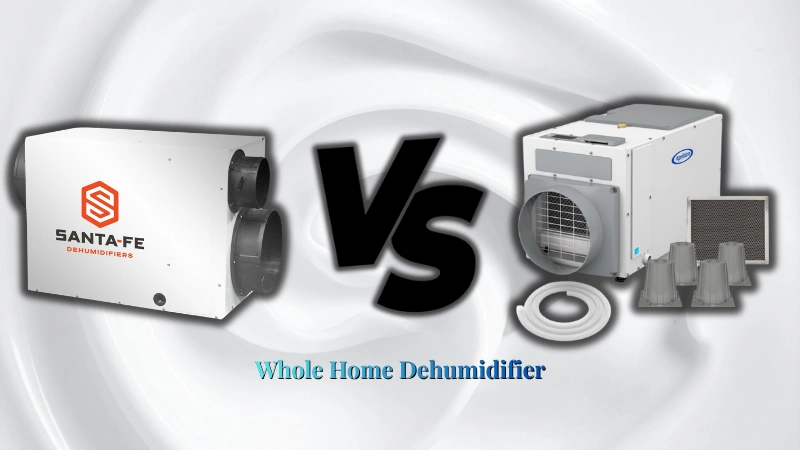
The decision between a Santa Fe and an AprilAire is not about finding a “best” dehumidifier. It is about selecting the correct engineering solution for your home’s unique ecosystem. Both represent a foundational shift away from treating symptoms toward installing permanent infrastructure.
At Total System Health, we view your home as a series of interconnected loops. Moisture management is the critical first domino. It protects your structure, enhances your mechanical HVAC systems, and reduces the biological and chemical burden on your body.
By investing in high-end humidity infrastructure, you are doing more than just drying the air; you are engineering a stable, resilient, and healthy baseline for your life. Remember: Health isn’t something you consume—it’s something you engineer.